Aquarium Spawns More Endangered White Abalone
Aquarium of the Pacific announces its latest efforts to help an endangered marine snail—the white abalone
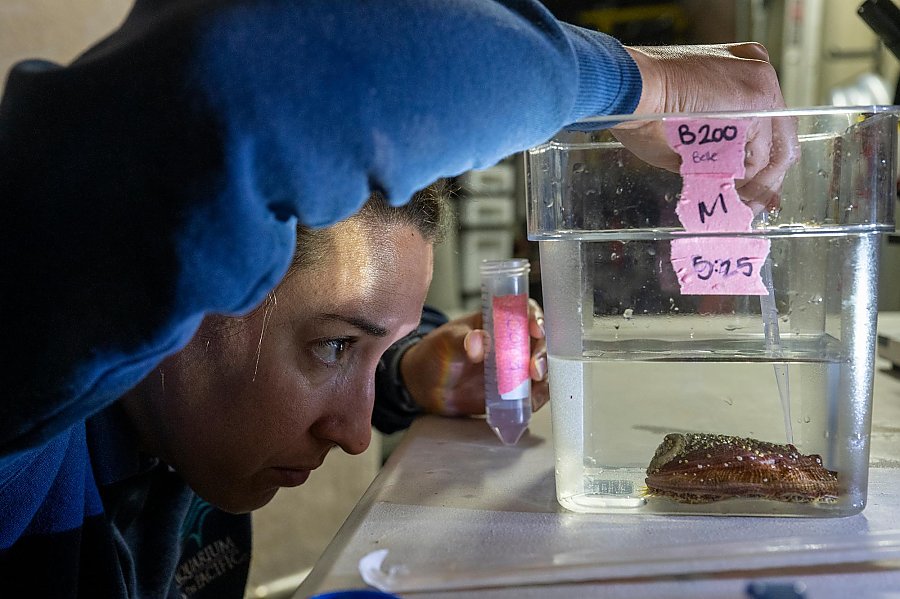
Mersades Hineman, Aquarium of the Pacific aquarist, helps with the white abalone spawning event Credit: Aquarium of the Pacific
May 6, 2026
In its ongoing quest to help save endangered white abalone, the Aquarium of the Pacific produced a successful spawn of these marine snails this year. This is all part of our effort to increase their populations off the California coast.
The twelve-hour spawning effort in started with an annual health assessment of each abalone. To start the spawning process, staff added the white abalone into individual buckets to track each animal’s spawning over the course of nearly eight hours. During this process, reproductive cells known as gametes are collected and are used to fertilize. Staff track fertilization rates and success in creating a white abalone zygote, a single-celled fertilized egg. Aquarium staff then monitor the first stages of development as the white abalone begins to grow.
“Spawning this endangered species is both rewarding and challenging, which is why every successful event feels like such an important milestone. Every success brings us closer to a future where they can thrive again off our coast,” said Johanna Hultberg, Aquarium’s conservation manager of fish and invertebrates.
Through close collaboration with partner institutions, Aquarium staff shared gametes from this February’s spawning event to support broader conservation efforts across the White Abalone Recovery Program. This collaboration helped to maximum reproductive success during the coordinated spawn and supported the development of the next generation.
In addition to the spawning event, Aquarium staff transferred over 1,800 juvenile white abalone this year to The Bay Foundation and the National Oceanic and Atmospheric Administration (NOAA) Southwest Fisheries Science Center as part of a collaborative effort to outplant these animals into the wild. Aquarium staff also traveled to the UC Davis Bodega Marine Lab to help with their abalone spawning event. The effort produced more than five million embryos, including nearly 100,000 microscopic white abalone that recently arrived at the Aquarium. These juveniles are now growing behind the scenes at the Aquarium while staff raise them until they are large enough to release back into the ocean.
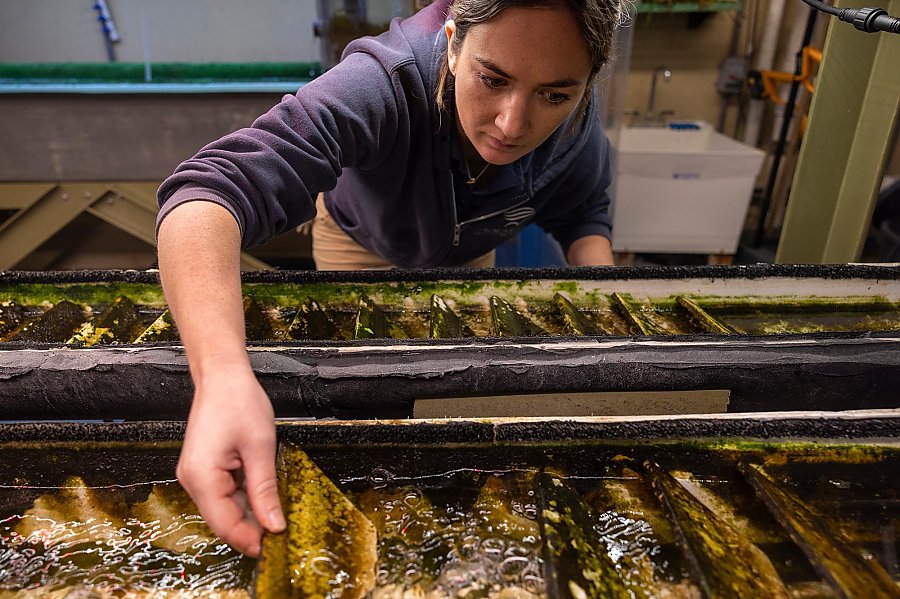
An Aquarium of the Pacific aquarist examines the ceramic tiles that abalone are grown on in their early stages of life. Credit: Aquarium of the Pacific
The Aquarium built custom troughs to help settle and manage abalone in its behind-the-scenes culturing area. Ceramic tiles conditioned with live algae, which mimic the surface of rocks with algae, have proven to be an effective substrate for rearing early life stages of white abalone. In these stages, the white abalone begins as plankton, floating in the water, but as the abalone develops and gains mass, the larvae sink to the bottom to settle. Since these stages are microscopic, the live algae provide a way to identify the tiles with settled white abalone. Where it may seem that the algae is “disappearing,” it is due to the white abalone eating the algae, indicating their presence.
Since 2007 the Aquarium has been working to further white abalone conservation through breeding, rearing, releasing, and monitoring this endangered marine invertebrate. In 2014 a coalition of various organizations was formed, including the Aquarium of the Pacific, the University of California, Davis’ Bodega Marine Laboratory, and the California Department of Fish and Wildlife with NOAA at the helm. Today nearly a dozen organizations are part of this effort. You can read more about white abalone conservation and the Aquarium’s white abalone breeding program here.
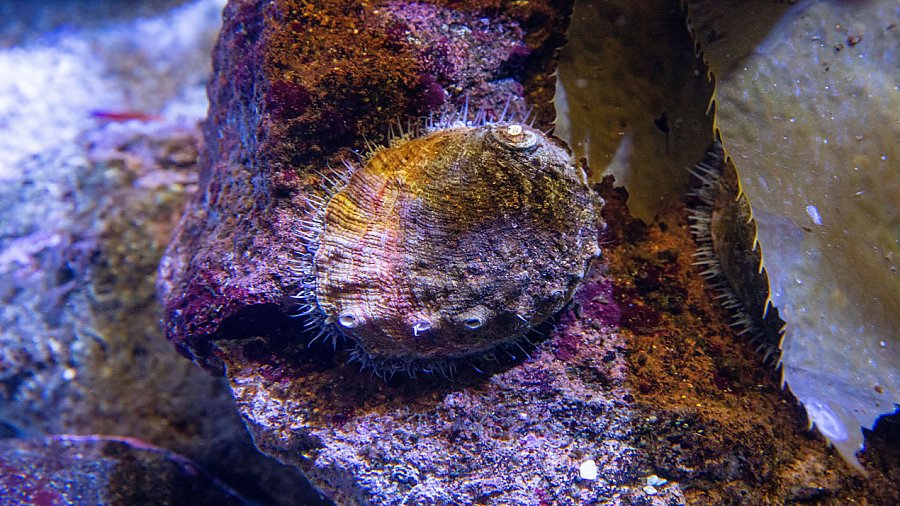
A white abalone on a rock. Credit: Aquarium of the Pacific
This endangered marine snail is one of the species on the Aquarium’s Marine Species Report Card. Their endangered status is a result of humans overharvesting white abalone in the 20th century until it was banned in 1997. A disease known as “withering syndrome” that caused declines in other California abalone, may have also impacted white abalone based on our understanding of their susceptibility to the disease in the laboratory. There is evidence that the stress of ocean warming and acidification may reduce abalone’s resistance to the disease and we are working with partners to learn how to mitigate this risk. Conservation groups, including the Aquarium of the Pacific, are monitoring the species’ wild populations and outplanting sites to give white and other species of abalone the best chance of survival and eventual recovery. More than 20,000 white abalone have been outplanted since 2019, and the Aquarium of the Pacific has been involved since the beginning of this conservation effort. You can learn more about white abalone here.
This is work is fueled by philanthropy. To learn more and support, please visit this donation page.
Aquarium guests can learn about white abalone and see them at a dedicated exhibit in the Southern California Gallery. There is a model of an abalone shell as well as a floor projection to show what an adult abalone looks like amid the algae on a rocky reef. You can check out a video monitor and signage for more information about these animals.