


Lion’s Mane Nudibranch
Melibe leonina
The lion’s mane nudibranch is a sea slug. They are known for their large hood-shaped mouth, which helps them catch floating plankton to eat. They can be found in kelp forests and sea grass along the Pacific coast of North America.
Originally published: February 20, 2026
Last updated: April 16, 2026
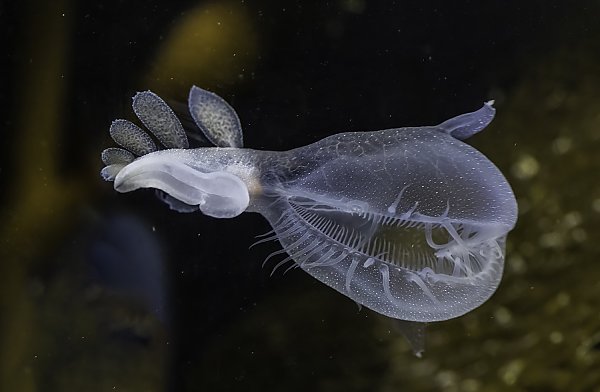
Credit: istockphoto / Gerald Corsi
SPECIES IN DETAIL
Lion’s Mane Nudibranch
Melibe leonina
CONSERVATION STATUS: Safe for Now
CLIMATE CHANGE: Uncertain
Geographic Distribution
Alaska to Baja California
Habitat
These are commonly found near the sea floor or on sea grass and blades of kelp. They are in shallow coastal waters up to depths of 37m (121 ft).
Physical Characteristics
Nudibranchs are sea slugs and have a soft body without a shell. Their name means “naked gill”, and these can be seen as round paddle-shaped projections on the back of the lion’s mane nudibranch. These structures allow the nudibranch to breathe by absorbing oxygen out of the water. Lion’s mane nudibranchs are usually transparent or sometimes pale yellow or pale green. This species lacks a radula (scraping tongue) and instead uses a hood shaped mouth to catch its food. Their eyes are located at the base of two small tentacles (rhinophores) on their hood.
Size
They are on average 102mm (4 inches) long and 25mm (0.9 in) wide.
Diet
They are active hunters and use their hood-like mouth to catch small plankton and crustaceans. They are swallowed whole. Unlike other nudibranchs, they lack a radula, a toothlike structure that can scrape up food.
Reproduction
Lion’s mane nudibranchs are simultaneous hermaphrodites, having both male and female reproductive organs but they cannot self-fertilize. They lay eggs which are fertilized internally and laid in protective gelatinous ribbons. The eggs hatch in about a week as free swimming larvae (veliger) which then settle and grow into adult nudibranchs.
Behavior
They usually are found near the ground but can swim by bending their body back and forth in a C shape.
Adaptation
These nudibranchs release a noxious secretion to defend themselves against predators. It is reported to have a sweet watermelon smell.
Longevity
The lifespan of this nudibranch is unknown.
Conservation
This species has not been evaluated by the IUCN. They can be affected by pollution and the warming conditions of climate change which can alter their kelp forest habitat.
Special Notes
Lion’s mane nudibranchs are the only species of this type (genus Melibe) found on the Pacific coast of North America.
SPECIES IN DETAIL | Print full entry
Lion’s Mane Nudibranch
Melibe leonina
CONSERVATION STATUS: Safe for Now
CLIMATE CHANGE: Uncertain
Alaska to Baja California
These are commonly found near the sea floor or on sea grass and blades of kelp. They are in shallow coastal waters up to depths of 37m (121 ft).
Nudibranchs are sea slugs and have a soft body without a shell. Their name means “naked gill”, and these can be seen as round paddle-shaped projections on the back of the lion’s mane nudibranch. These structures allow the nudibranch to breathe by absorbing oxygen out of the water. Lion’s mane nudibranchs are usually transparent or sometimes pale yellow or pale green. This species lacks a radula (scraping tongue) and instead uses a hood shaped mouth to catch its food. Their eyes are located at the base of two small tentacles (rhinophores) on their hood.
They are on average 102mm (4 inches) long and 25mm (0.9 in) wide.
They are active hunters and use their hood-like mouth to catch small plankton and crustaceans. They are swallowed whole. Unlike other nudibranchs, they lack a radula, a toothlike structure that can scrape up food.
Lion’s mane nudibranchs are simultaneous hermaphrodites, having both male and female reproductive organs but they cannot self-fertilize. They lay eggs which are fertilized internally and laid in protective gelatinous ribbons. The eggs hatch in about a week as free swimming larvae (veliger) which then settle and grow into adult nudibranchs.
They usually are found near the ground but can swim by bending their body back and forth in a C shape.
These nudibranchs release a noxious secretion to defend themselves against predators. It is reported to have a sweet watermelon smell.
The lifespan of this nudibranch is unknown.
This species has not been evaluated by the IUCN. They can be affected by pollution and the warming conditions of climate change which can alter their kelp forest habitat.
Lion’s mane nudibranchs are the only species of this type (genus Melibe) found on the Pacific coast of North America.