


White’s Tree Frog
Litoria caerulea
These frogs were first described by John White, hence the common name, White’s. The tree part of their name comes from their preferred habitat of tree canopies. White’s tree frogs are also known as the dumpy tree frogs, green tree frogs, giant green frogs (Florida), and Australian green tree frogs. They are described as quiet, very gentle, laid back animals that, unlike most of their relatives, are not into jumping. They are popular exotic pets worldwide.
Originally published: August 03, 2007
Last updated: October 29, 2024
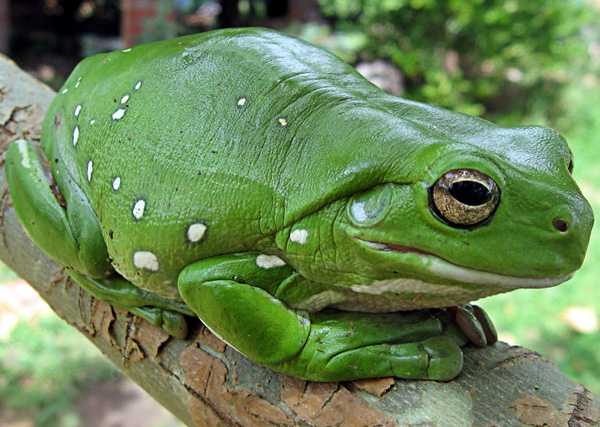
Credit: LiquidGhoul. Released to public domain.
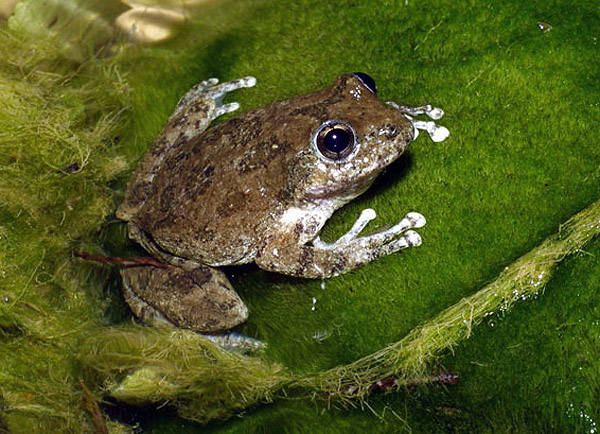
California's tree frog, Hyla cadaverina Credit: Courtesy of USGS
SPECIES IN DETAIL
White’s Tree Frog
Litoria caerulea
CONSERVATION STATUS: Safe for Now - Protected
CLIMATE CHANGE: Vulnerable
Geographic Distribution
Native: southern New Guinea, Indonesia, and widely distributed in Australia, especially in the north and east. Introduced: Florida and New Zealand
Habitat
This species is a habitat generalist, highly adaptable to different environments ranging from coastal to arid habitats. Typically these frogs are arboreal, inhabiting tree canopies near still water sources, but they are also found in woodlands far from water, grasslands, near streams and swamps on rocks, and in rock crevices and hollow tree trunks. They have adapted to suburban and urban areas where there are water sources: canals and drainage ditches, toilets, sinks, water tanks, and gutters. In New Guinea, they inhabit open monsoon forests in addition to gardens and parts of human dwellings.
Physical Characteristics
The head of the White’s tree frog blends into the body— there is no obvious neck. The mouth is short and blunt. The legs of these frogs are short with long thick toes that end in wide, irregular-shaped pads. The fingers are about one-third webbed while the webbing of the toes is almost three-quarters. The skin on the back is smooth and granular on the sides. Adults have a well-developed lumpy or fleshy fold behind each eye, (the supratympanal ridge), that may be partially covered by the tympanums (similar to eardrums), which are visible on both sides of the head. Males have a wrinkled, grayish-colored vocal sac underneath the throat region, while females have white throats.
The color of these frogs comes from blue and green pigments that are overlaid by yellow. The variation in coloration is dependent on temperature and color of the environment they inhabit. The dorsal side may be jade-green, blue-green, or olive. Both sexes may have irregular shaped white markings or distinct stripes on the sides and spots from the corner of the mouth to the base of the arms. There may be a white stripe along the hind edge of the lower leg and outer edge of the fifth toe. Coloration of the thighs varies from yellow to maroon. The ventral surface can be white or a grayish to yellowish white. The throat of females is white. Eyes are a golden color with horizontal irises.
Size
Females are 3.9 to 5.9 inches (10 to 15 centimeters) snout to vent in length. Males are about 1 inch (2.54 centimeters) smaller.
Diet
Adult White’s tree frogs are primarily insectivores, eating grasshoppers, mosquitoes, beetles, flies, moths, and spiders. They also eat small mammals. When the prey is small enough, the frog propels its tongue out of its mouth to capture the insect on its sticky surface. They capture larger prey by pouncing on it and seizing it with their hands to force the meal into their mouths. Tadpoles are omnivores. They eat algae, mosquito larvae, drowned insects, and tadpoles of other species.
Reproduction
These frogs become sexually mature at about two years of age. Individual males start calling early in October from exposed, elevated surfaces to attract a female. Breeding season is from November to February when an attracted female will meet the male at a still water source. Mating take place in shallow water where the pair remains in amplexus for about two days. The female rapidly ejects 200-300 brown eggs that the male fertilizes during ejection. The eggs that are 1.1-1.4 mm (0.04-0.06 in) in diameter and encased in clear jelly are deposited on the surface of still water. The spawn sinks within 24 hours. Eggs are ejected and fertilized several times for about two days. A total of 2,000-3,000 eggs are deposited.
The eggs hatch in three days if the water depth and temperature are suitable. Tadpoles are a mottled brown on hatching. Metamorphose from tadpoles to froglets to adults takes two months in the wild.
Behavior
White’s tree frogs are nocturnal, hunting for prey at night. During the day they look for cool, dark, and moist places to sleep. Their calls, made from high positions such as trees and gutters during most of the year, are low, slow, and repeated many times. In breeding season they descend closer to still-water sources where the males make a deep repeated crawk, crawk, crawk or barking sound to attract a female. They have an ear-piercing stress call that they issue when a predator is close
Adaptation
Prior to the mating season, the male develops a black nuptial pad on the inner surface of the thumb that enables him to hang onto the female for the duration of their mating that may be as long as two days.
To survive dry seasons, these frogs may burrow and cover themselves with a cocoon of sloughed skin and mucus to retain moisture.
Longevity
White’s tree frogs have been known to live 23 years in a protected environment such as an aquarium. Their life span in the wild is probably shorter.
Conservation
This tree frog species is classified as a species of least concern on the IUCN Red List because of their wide distribution, tolerance of a wide range of habitats, and their presumed large populations. White’s tree frogs are protected in Australia under the country’s Environmental Protection and Biodiversity Conservation Act of 1999. Special permits are required to keep them as pets and to export them. There are some concerns that the exportation of large numbers of the Indonesian population for the international pet trade may impact this geographic population. In Florida these frogs are bred for the pet industry in orchid shade houses from which some escape. Escapees and intentional releases are believed to be the source of the introduction of this species into Florida.
In the wild, they are preyed on by snakes and some birds and lizards. In suburban areas, predation by cats and dogs and pollution may reduce the number of tree frogs.
Special Notes
Like humans, White’s tree frogs get obese if overfed. They deposit fat layers over the top of the head and body that give these frogs a dumpy appearance, the source of one of their common names, dumpy frog.
The skin secretions of these frogs are lethal to blowflies. They contain peptides that have high antibacterial and antiviral properties and caerulens that may affect digestion. The secretions are being studied by the pharmaceutical industry for use in treating human illnesses and for use as an insecticide
SPECIES IN DETAIL | Print full entry
White’s Tree Frog
Litoria caerulea
CONSERVATION STATUS: Safe for Now - Protected
CLIMATE CHANGE: Vulnerable
Native: southern New Guinea, Indonesia, and widely distributed in Australia, especially in the north and east. Introduced: Florida and New Zealand
This species is a habitat generalist, highly adaptable to different environments ranging from coastal to arid habitats. Typically these frogs are arboreal, inhabiting tree canopies near still water sources, but they are also found in woodlands far from water, grasslands, near streams and swamps on rocks, and in rock crevices and hollow tree trunks. They have adapted to suburban and urban areas where there are water sources: canals and drainage ditches, toilets, sinks, water tanks, and gutters. In New Guinea, they inhabit open monsoon forests in addition to gardens and parts of human dwellings.
The head of the White’s tree frog blends into the body— there is no obvious neck. The mouth is short and blunt. The legs of these frogs are short with long thick toes that end in wide, irregular-shaped pads. The fingers are about one-third webbed while the webbing of the toes is almost three-quarters. The skin on the back is smooth and granular on the sides. Adults have a well-developed lumpy or fleshy fold behind each eye, (the supratympanal ridge), that may be partially covered by the tympanums (similar to eardrums), which are visible on both sides of the head. Males have a wrinkled, grayish-colored vocal sac underneath the throat region, while females have white throats.
The color of these frogs comes from blue and green pigments that are overlaid by yellow. The variation in coloration is dependent on temperature and color of the environment they inhabit. The dorsal side may be jade-green, blue-green, or olive. Both sexes may have irregular shaped white markings or distinct stripes on the sides and spots from the corner of the mouth to the base of the arms. There may be a white stripe along the hind edge of the lower leg and outer edge of the fifth toe. Coloration of the thighs varies from yellow to maroon. The ventral surface can be white or a grayish to yellowish white. The throat of females is white. Eyes are a golden color with horizontal irises.
Females are 3.9 to 5.9 inches (10 to 15 centimeters) snout to vent in length. Males are about 1 inch (2.54 centimeters) smaller.
Adult White’s tree frogs are primarily insectivores, eating grasshoppers, mosquitoes, beetles, flies, moths, and spiders. They also eat small mammals. When the prey is small enough, the frog propels its tongue out of its mouth to capture the insect on its sticky surface. They capture larger prey by pouncing on it and seizing it with their hands to force the meal into their mouths. Tadpoles are omnivores. They eat algae, mosquito larvae, drowned insects, and tadpoles of other species.
These frogs become sexually mature at about two years of age. Individual males start calling early in October from exposed, elevated surfaces to attract a female. Breeding season is from November to February when an attracted female will meet the male at a still water source. Mating take place in shallow water where the pair remains in amplexus for about two days. The female rapidly ejects 200-300 brown eggs that the male fertilizes during ejection. The eggs that are 1.1-1.4 mm (0.04-0.06 in) in diameter and encased in clear jelly are deposited on the surface of still water. The spawn sinks within 24 hours. Eggs are ejected and fertilized several times for about two days. A total of 2,000-3,000 eggs are deposited.
The eggs hatch in three days if the water depth and temperature are suitable. Tadpoles are a mottled brown on hatching. Metamorphose from tadpoles to froglets to adults takes two months in the wild.
White’s tree frogs are nocturnal, hunting for prey at night. During the day they look for cool, dark, and moist places to sleep. Their calls, made from high positions such as trees and gutters during most of the year, are low, slow, and repeated many times. In breeding season they descend closer to still-water sources where the males make a deep repeated crawk, crawk, crawk or barking sound to attract a female. They have an ear-piercing stress call that they issue when a predator is close
Prior to the mating season, the male develops a black nuptial pad on the inner surface of the thumb that enables him to hang onto the female for the duration of their mating that may be as long as two days.
To survive dry seasons, these frogs may burrow and cover themselves with a cocoon of sloughed skin and mucus to retain moisture.
White’s tree frogs have been known to live 23 years in a protected environment such as an aquarium. Their life span in the wild is probably shorter.
This tree frog species is classified as a species of least concern on the IUCN Red List because of their wide distribution, tolerance of a wide range of habitats, and their presumed large populations. White’s tree frogs are protected in Australia under the country’s Environmental Protection and Biodiversity Conservation Act of 1999. Special permits are required to keep them as pets and to export them. There are some concerns that the exportation of large numbers of the Indonesian population for the international pet trade may impact this geographic population. In Florida these frogs are bred for the pet industry in orchid shade houses from which some escape. Escapees and intentional releases are believed to be the source of the introduction of this species into Florida.
In the wild, they are preyed on by snakes and some birds and lizards. In suburban areas, predation by cats and dogs and pollution may reduce the number of tree frogs.
Like humans, White’s tree frogs get obese if overfed. They deposit fat layers over the top of the head and body that give these frogs a dumpy appearance, the source of one of their common names, dumpy frog.
The skin secretions of these frogs are lethal to blowflies. They contain peptides that have high antibacterial and antiviral properties and caerulens that may affect digestion. The secretions are being studied by the pharmaceutical industry for use in treating human illnesses and for use as an insecticide