


Humpback Whale
Megaptera novaeangliae
Humpback whales are mysticetes, (baleen whales), in the family Balaenopteridae which includes fin, blue, sei, Bryde’s, and minke whales, the rorquals. All rorquals have a small dorsal fin and longitudinal throat grooves or pleats from their chin to their navel that expand when they feed. The common name, humpback, comes from this whale’s appearance when it arches its back out of the water in preparation for a long dive. These whales are noted for their haunting songs, acrobatic behaviors, and the cooperative feeding methods they use. Easily identified because of the distinctive variability of the black and white patterns on the undersides of their flukes, photo-identification of humpbacks whales started in 1970. Today humpback whales and orcas are the most studied of all the cetaceans.
Originally published: July 09, 2007
Last updated: April 03, 2020
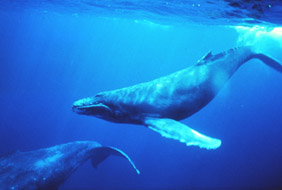
In singing position. Credit: Courtesy of NOAA
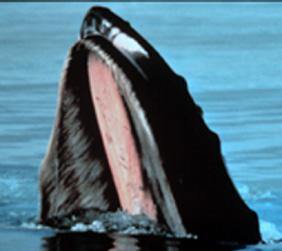
Baleen Credit: Courtesy of NOAA
SPECIES IN DETAIL
Humpback Whale
Megaptera novaeangliae
CONSERVATION STATUS: Endangered - Protected
CLIMATE CHANGE: Not Applicable
Geographic Distribution
All regions of the world ocean to the margins of ice packs with distribution changing seasonally. Non-migrating population in the Arabian Sea.
Habitat
During summer months these seasonal migrants are found near oceanic islands, coastal areas, and over the continental shelf,or at its edges feeding in relatively shallow temperate and cold waters. They migrate to tropical waters during the winter where they breed and calve. They may travel across deep ocean waters during their migrations.
Physical Characteristics
Humpback whales have a rounded bulky body ending in broad, deeply notched flukes that have irregular knobby trailing edges and pointed tips. There are fleshy knobs called tubercles on their head forward of their two blowholes and on the leading edge of the lower jaw. Each contains a single bristly hair that scientists believe may have a sensory function. No other whale has these tubercles. There may also be clusters of barnacles on the head and a protuberance at the tip of the lower jaw. There are 12-50 throat grooves or pleats on the ventral side of their body extending from the tip of the lower jaw to just beyond the navel. This is a smaller number of throat grooves than most rorquals have. Their long, narrow, wing-like flippers (pectoral fins) have knobby trailing edges. The shape of the dorsal fin is variable ranging from low and stubby with a broad base to high and falcate (curved). There is often a prominent hump in front of the dorsal fin.
Their baleen is made of keratin, (the same material as human hair and fingernails and cattle horns) and consists of 270-400 usually all black or grayish-black, thin, coarse, and stiff plates that hang from each side of the upper jaw. The plates are up to 0.6 m (25 in) long and 34 cm (13.4 in) wide.
The body of humpback whales is usually blue-black or black overall with irregular white coloration on the throat and sides. The belly may be black, entirely white, or mottled. The undersides of the extraordinarily long flippers are usually white whereas the color of the top depends on the geographic location of the whale population. Those found in the North Atlantic and Southern Hemisphere have mostly white dorsal surfaces and North Pacific whales, mostly black. Flukes are black above and black and white patterned on the underside which is usually visible when the whale dives. The ventral coloration is as distinctive and unique in these whales as fingerprints are in humans. There may be a number of scars on the body.
Size
Adult females are 13.7-15.2 m (45-50 ft) in length. They are slightly larger than males which are 12.2-14.6 m (40-48 ft) long. Mature humpbacks weight 30,000-48,000 kg (66,000-106,000 lb). Southern Hemisphere whales are slightly larger than Northern. Flukes can be as wide as 5.5 m (18 ft) and flippers 1/2 to 2/3 the length of the whale’s body, the longest of all the whales.
Diet
It is estimated that adult humpbacks eat 1360 kg (2998 lb) of food each day.
Northern Hemisphere humpbacks prefer a diet of small fishes (herring, capelin, mackerel, and sandlance), and krill, small shrimp-like crustaceans while the diet of Southern Hemisphere whales is primarily Antarctic krill, Euphausia superba. They lack teeth to grip and tear large prey into small easily swallowed pieces, so items on their menu must be small.
Humpbacks are filter feeders. Their baleen plates have bristly inner edges that intertwine to form a strainer or filter. Although their large mouth opens to an angle greater than 90o, like most baleen whales, their throat is so small that they cannot swallow large prey. Normally feeding in the top 100 m (330 ft) of the water column, they lunge at their meal, plowing through concentrated swarms or schools of prey with huge mouth open and throat grooves expanding to form a large sack to take in as much as 10,000 liters (2642 gal) of food-laden water. The water is expelled through the baleen and the whale uses its large rasping tongue to maneuver the food retained on the inner surface of the baleen to its throat to be swallowed whole.
In addition to lunging, humpbacks have several other unique feeding behaviors some of which involve blowing bubbles by one whale or by several hunting cooperatively.
- Bubble netting: One or more whales dive beneath a school of fish and swim upward in ever smaller concentric circles as they release streams of air from their blowholes to create bubbles. The bubbles rise in a net around the fish seeming to form a barrier that the fish will not pass. The whale(s) then swim up through the middle of the net, mouth wide open to feed
- Bubble feeding: Pod exhales columns of bubbles to herd prey into a ball, then lunge feed in formation
- Bubble cloud: Burst of bubbles up to 20 m (66 ft) across traps prey between the surface and the rising cloud for lunge feeding.
Reproduction
Humpback whales reach sexual maturity between six and ten years of age. Their breeding areas are fairly well known, unlike those of most other baleen whales. Males court females with song. (See Adaptation for information about vocalization of humpbacks.) They also engage in vigorous, even violent competition, for mates. On the breeding grounds there may be two to more than 20 males around a single female with the group composition changing periodically. When a male, called a joiner, approaches a singer and tries to get close to the female being courted, the males lunge at each other, lash with flukes, flippers, and tails, and blow clouds of bubbles. Head slapping, butting, and serious push and shove behavior is exhibited.
The gestation period is 11-12 months. When ready to give birth, the female seeks a relatively shallow inshore area where she may be safe from sharks, boats, and aggressive males. The calf is 4-4.6 m (13-15 ft) long at birth and weighs about 680 kg (1500 lb). The calf nurses for 8-11 months, supplementing its milk diet with seafood when it is six months old. It gains weight rapidly consuming milk that is 45-60% butterfat.
Often a cow-calf pair is accompanied by another adult known as an escort. Escorts can be of either sex but are most often males seeking to breed. The escort remains with the pair for only a few hours.
Behavior
Migration: Depending on starting and ending points, humpbacks may have one of the longest migrations of any mammal, traveling as many as 16.000 km (10,000 mi).They usually travel in small groups of three to four whales. Different populations follow definite paths, usually the same route each year, as they migrate from summer feeding grounds in cold and temperate waters to warmer water winter breeding and calving areas. Immature whales do not always make the entire migration, stopping at points along the way. The populations in the various parts of the world ocean are all genetically separate subspecies and, while they may co-mingle in breeding grounds, they rarely if ever interbreed. The group inhabiting the Arabian Sea does not seem to migrate.
In the western North Pacific the whales that breed and calve around Japanese islands probably travel to the Bering Sea and the Aleutian Islands to feed over summer/fall. The coastal Central America and Mexican whales feed off of the coast of California to southern British Columbia. Hawaii’s breeding/calving population migrates to northern British Columbia, southeast Alaska, and Prince William Sound west to Kodiak.
The North Atlantic populations feed between the Gulf of Maine, Iceland, and Greenland and off the coast of Norway. The western Atlantic whales migrate to the Caribbean to winter although recently juveniles have been sighted from Delaware to North Carolina. The eastern Atlantic humpbacks breed and calve off the coast of Africa and the Cape Verde Islands. During the austral summer the Southern Hemisphere’s six main humpback populations intermingle while feeding in the Southern Ocean around Antarctica. However, they usually return to their home areas on each side of Australia, Africa, and South America to breed and calve.
Blow: The blow of humpback whales is low, rounded, and more bushy than other rorquals. In preparation for a deep dive they take 4-8 breaths at 1-2 minute intervals and then dive to a depth of 150-210 m (492-689 ft). In the breeding grounds (where they do not usually feed), they blow 3-6 times between dives. The average dive lasts up to 15 minutes. When feeding, they usually swim 1.9-5.6 km/hr (0.2 -3.5 mph). Otherwise their swimming speed is 4.8-14 km/hr (3-9 mph).
The Acrobatic Whales: Humpbacks have a repertoire of spectacular acrobatic behaviors. Many of their displays seem to be involved in courtship and breeding, while reasons for others are still not well explained. .
- breaching: lifting as much as two thirds of the body out of the water and landing on the surface belly down or on the side with a thunderous splash. The breach of a humpback is the most dramatic of all whales. Is this to get rid of parasites, communicate with other whales, a courtship display, a temper tantrum, or just for fun?
- spyhopping: lifting the head out of the water vertically, usually clearing the eyes above the water surface to scan for about 30 seconds, then slowly sinking down. The whale does not swim when spyhopping but relies on exception buoyancy control and position with its flippers. Why look around? Perhaps, to see who is in the area, where obstacles are, to navigate, or just out of curiosity.
- head lunging : thrusts head toward another whale in a threatening posture, often butting it. An aggressive mood to chase away competitors for attentions of females?
- head slap: head forcefully hurled onto surface of water. Another aggressive move?
- flipper slap: slapping surface of water forcefully with a flipper. Communication?
- flipper waving: while lying on its side, lifts entire flipper above the water for as long as an hour. Attract a mate? Occurs in or near breeding areas.
- tail lobbing: raising fluke out of the water and then slapping it on the surface. Aggressive temper tantrum or communication?
Adaptation
Known as the singing whales, male humpbacks are the vocalists, not females. The singing male positions himself vertically in the water head down and sings a song that is loud, repetitive, and the most complex sung by any animal in the world. It is made up of grunts, chirps, violin-like sounds, rumbles, whoos, and eees. Phrases are organized into themes and the themes into songs that may be sung over and over being repeated for hours. The low frequency noises can travel 30-35 km (18.6-21.8 mi). Although the songs of individuals may vary somewhat, all whales in a group sing essentially the same song which differs from that of other populations, i.e., there is a regional dialect. A portion of the song is changed each breeding season with some parts deleted and new ones added. All males in the group make the changes.
In the breeding grounds the singing is to attract a mate and singing decreases markedly when the whales start their migration to feeding grounds. In addition to mate attraction as a reason for singing, other reasons may be to show dominance or aggression, a way to stay in touch on the migration or give information about the journey, or to let others know the location of prey, important in cooperative feeding.
Longevity
The life span of humpback whales is estimated to be 45-50 years.
Conservation
In late December 2012, NOAA announced that beginning in 2013, shipping lanes along the California coast would be adjusted to protect feeding and congregating humpback, blue, and fin whales from ship strikes. The lane changes include the approaches to San Francisco Bay, Santa Barbara Channel, and the ports of Los Angeles and Long Beach. In November 2012 the International Maritime Organization which governs shipping worldwide adopted the proposed changes
Slower swimming than most of the more streamlined great whales and frequenting coastal waters in predictable breeding and feeding areas, humpbacks were targeted by whalers before the advent of faster ships made pursuing blue whales and other fast deep-water swimmers feasible. They were facing extinction when a moratorium was placed on catching them in the North Atlantic in 1956. 1963 in the Southern Ocean, and 1966 in the North Pacific. It is estimated that more than 250,000 had been killed by 1966. Recovery since the moratoriums has been steady for most, but not all populations to a total number believed to be between 35,000 and 40,000 worldwide today. NOAA Fisheries estimates that there are about 17,000 “American” humpback whales.
Although these whales are not presently hunted commercially, they still encounter human generated threats of noise pollution caused by shipping and military SONAR testing affecting their communication, entanglement in fishing gear, biological effects of chemical pollution, ship collisions, overfishing of krill, and potential effects of global climate changes on the supply of krill in the Southern Ocean. Disturbances caused by whale watch boats may be a factor in New England’s coastal feeding habitats and Hawaii’s breeding grounds where seasonal boat traffic is high. The NMFS has in place both a recovery plan that focuses on ways to help the whales recover from detrimental human impacts and a plan to reduce the number of entanglements in fishing gear. Both seem to be effective.
Humpback whales are protected under the U.S. Marine Mammal Protection Act. They are listed as endangered under the Endangered Species Act and as vulnerable on the IUCN Red List. The IWC permits the Bequians of St. Vincent and the Grenadines in the eastern Caribbean to take four humpback whales each year from 2003-2007. The meat and products are to be used exclusively by the Bequians, and not sold.
Special Notes
SPLASH!: How many humpbacks are there across the North Pacific? What are there migratory routes and destinations? What is their genetic diversity? How are humans impacting them? SPLASH! Is an international cooperative effort among U.S., Mexican, Canadian, and Japanese researchers, academic and private institutions, NOAA Fisheries, and the National Marine Sanctuary Program to study humpback whales in an effort to find definitive answers to these and other questions. The research began in January 2004 and reported in 2008 indicated that the number of humpback whales in the North Pacific Ocean has increased since international and federal protections were enacted in the 1960s and 70s.However, some isolated populations of humpbacks, especially those in the Western Pacific Ocean, have not recovered at the same rate and still suffer low numbers.NOAA report
Humpback Whales and Star Trek IV: The Voyage Home: An alien spaceship appears over 23rd century Earth, transmitting unidentified sounds toward the planet. Authorities on Earth, unable to decipher the message, do not respond so the alien ship begins storms on Earth that threaten to destroy humankind. Captain Kirk and Mr. Spock finally figure out that the sounds are humpback whales singing. They were not recognized initially because humpbacks became extinct in the 21st century. The aliens had apparently visited Earth long before man’s technological development and recognized humpbacks as intelligent, feeling (sentient) beings. The fact that a sentient species had been allowed to die indicates to the aliens that the current top dogs have no business running a planet. Kirk and crew have only one choice to save humankind and that is to attempt to time travel back into the 20th century, locate a breeding pair of humpbacks, and bring them back to 23rd century Earth to communicate with the probe. So back they go. Fortunately, they locate a pair of humpback whales that, when brought back, communicate with the probe and Earth is saved.
SPECIES IN DETAIL | Print full entry
Humpback Whale
Megaptera novaeangliae
CONSERVATION STATUS: Endangered - Protected
CLIMATE CHANGE: Not Applicable
All regions of the world ocean to the margins of ice packs with distribution changing seasonally. Non-migrating population in the Arabian Sea.
During summer months these seasonal migrants are found near oceanic islands, coastal areas, and over the continental shelf,or at its edges feeding in relatively shallow temperate and cold waters. They migrate to tropical waters during the winter where they breed and calve. They may travel across deep ocean waters during their migrations.
Humpback whales have a rounded bulky body ending in broad, deeply notched flukes that have irregular knobby trailing edges and pointed tips. There are fleshy knobs called tubercles on their head forward of their two blowholes and on the leading edge of the lower jaw. Each contains a single bristly hair that scientists believe may have a sensory function. No other whale has these tubercles. There may also be clusters of barnacles on the head and a protuberance at the tip of the lower jaw. There are 12-50 throat grooves or pleats on the ventral side of their body extending from the tip of the lower jaw to just beyond the navel. This is a smaller number of throat grooves than most rorquals have. Their long, narrow, wing-like flippers (pectoral fins) have knobby trailing edges. The shape of the dorsal fin is variable ranging from low and stubby with a broad base to high and falcate (curved). There is often a prominent hump in front of the dorsal fin.
Their baleen is made of keratin, (the same material as human hair and fingernails and cattle horns) and consists of 270-400 usually all black or grayish-black, thin, coarse, and stiff plates that hang from each side of the upper jaw. The plates are up to 0.6 m (25 in) long and 34 cm (13.4 in) wide.
The body of humpback whales is usually blue-black or black overall with irregular white coloration on the throat and sides. The belly may be black, entirely white, or mottled. The undersides of the extraordinarily long flippers are usually white whereas the color of the top depends on the geographic location of the whale population. Those found in the North Atlantic and Southern Hemisphere have mostly white dorsal surfaces and North Pacific whales, mostly black. Flukes are black above and black and white patterned on the underside which is usually visible when the whale dives. The ventral coloration is as distinctive and unique in these whales as fingerprints are in humans. There may be a number of scars on the body.
Adult females are 13.7-15.2 m (45-50 ft) in length. They are slightly larger than males which are 12.2-14.6 m (40-48 ft) long. Mature humpbacks weight 30,000-48,000 kg (66,000-106,000 lb). Southern Hemisphere whales are slightly larger than Northern. Flukes can be as wide as 5.5 m (18 ft) and flippers 1/2 to 2/3 the length of the whale’s body, the longest of all the whales.
It is estimated that adult humpbacks eat 1360 kg (2998 lb) of food each day.
Northern Hemisphere humpbacks prefer a diet of small fishes (herring, capelin, mackerel, and sandlance), and krill, small shrimp-like crustaceans while the diet of Southern Hemisphere whales is primarily Antarctic krill, Euphausia superba. They lack teeth to grip and tear large prey into small easily swallowed pieces, so items on their menu must be small.
Humpbacks are filter feeders. Their baleen plates have bristly inner edges that intertwine to form a strainer or filter. Although their large mouth opens to an angle greater than 90o, like most baleen whales, their throat is so small that they cannot swallow large prey. Normally feeding in the top 100 m (330 ft) of the water column, they lunge at their meal, plowing through concentrated swarms or schools of prey with huge mouth open and throat grooves expanding to form a large sack to take in as much as 10,000 liters (2642 gal) of food-laden water. The water is expelled through the baleen and the whale uses its large rasping tongue to maneuver the food retained on the inner surface of the baleen to its throat to be swallowed whole.
In addition to lunging, humpbacks have several other unique feeding behaviors some of which involve blowing bubbles by one whale or by several hunting cooperatively.
- Bubble netting: One or more whales dive beneath a school of fish and swim upward in ever smaller concentric circles as they release streams of air from their blowholes to create bubbles. The bubbles rise in a net around the fish seeming to form a barrier that the fish will not pass. The whale(s) then swim up through the middle of the net, mouth wide open to feed
- Bubble feeding: Pod exhales columns of bubbles to herd prey into a ball, then lunge feed in formation
- Bubble cloud: Burst of bubbles up to 20 m (66 ft) across traps prey between the surface and the rising cloud for lunge feeding.
Humpback whales reach sexual maturity between six and ten years of age. Their breeding areas are fairly well known, unlike those of most other baleen whales. Males court females with song. (See Adaptation for information about vocalization of humpbacks.) They also engage in vigorous, even violent competition, for mates. On the breeding grounds there may be two to more than 20 males around a single female with the group composition changing periodically. When a male, called a joiner, approaches a singer and tries to get close to the female being courted, the males lunge at each other, lash with flukes, flippers, and tails, and blow clouds of bubbles. Head slapping, butting, and serious push and shove behavior is exhibited.
The gestation period is 11-12 months. When ready to give birth, the female seeks a relatively shallow inshore area where she may be safe from sharks, boats, and aggressive males. The calf is 4-4.6 m (13-15 ft) long at birth and weighs about 680 kg (1500 lb). The calf nurses for 8-11 months, supplementing its milk diet with seafood when it is six months old. It gains weight rapidly consuming milk that is 45-60% butterfat.
Often a cow-calf pair is accompanied by another adult known as an escort. Escorts can be of either sex but are most often males seeking to breed. The escort remains with the pair for only a few hours.
Migration: Depending on starting and ending points, humpbacks may have one of the longest migrations of any mammal, traveling as many as 16.000 km (10,000 mi).They usually travel in small groups of three to four whales. Different populations follow definite paths, usually the same route each year, as they migrate from summer feeding grounds in cold and temperate waters to warmer water winter breeding and calving areas. Immature whales do not always make the entire migration, stopping at points along the way. The populations in the various parts of the world ocean are all genetically separate subspecies and, while they may co-mingle in breeding grounds, they rarely if ever interbreed. The group inhabiting the Arabian Sea does not seem to migrate.
In the western North Pacific the whales that breed and calve around Japanese islands probably travel to the Bering Sea and the Aleutian Islands to feed over summer/fall. The coastal Central America and Mexican whales feed off of the coast of California to southern British Columbia. Hawaii’s breeding/calving population migrates to northern British Columbia, southeast Alaska, and Prince William Sound west to Kodiak.
The North Atlantic populations feed between the Gulf of Maine, Iceland, and Greenland and off the coast of Norway. The western Atlantic whales migrate to the Caribbean to winter although recently juveniles have been sighted from Delaware to North Carolina. The eastern Atlantic humpbacks breed and calve off the coast of Africa and the Cape Verde Islands. During the austral summer the Southern Hemisphere’s six main humpback populations intermingle while feeding in the Southern Ocean around Antarctica. However, they usually return to their home areas on each side of Australia, Africa, and South America to breed and calve.
Blow: The blow of humpback whales is low, rounded, and more bushy than other rorquals. In preparation for a deep dive they take 4-8 breaths at 1-2 minute intervals and then dive to a depth of 150-210 m (492-689 ft). In the breeding grounds (where they do not usually feed), they blow 3-6 times between dives. The average dive lasts up to 15 minutes. When feeding, they usually swim 1.9-5.6 km/hr (0.2 -3.5 mph). Otherwise their swimming speed is 4.8-14 km/hr (3-9 mph).
The Acrobatic Whales: Humpbacks have a repertoire of spectacular acrobatic behaviors. Many of their displays seem to be involved in courtship and breeding, while reasons for others are still not well explained. .
- breaching: lifting as much as two thirds of the body out of the water and landing on the surface belly down or on the side with a thunderous splash. The breach of a humpback is the most dramatic of all whales. Is this to get rid of parasites, communicate with other whales, a courtship display, a temper tantrum, or just for fun?
- spyhopping: lifting the head out of the water vertically, usually clearing the eyes above the water surface to scan for about 30 seconds, then slowly sinking down. The whale does not swim when spyhopping but relies on exception buoyancy control and position with its flippers. Why look around? Perhaps, to see who is in the area, where obstacles are, to navigate, or just out of curiosity.
- head lunging : thrusts head toward another whale in a threatening posture, often butting it. An aggressive mood to chase away competitors for attentions of females?
- head slap: head forcefully hurled onto surface of water. Another aggressive move?
- flipper slap: slapping surface of water forcefully with a flipper. Communication?
- flipper waving: while lying on its side, lifts entire flipper above the water for as long as an hour. Attract a mate? Occurs in or near breeding areas.
- tail lobbing: raising fluke out of the water and then slapping it on the surface. Aggressive temper tantrum or communication?
Known as the singing whales, male humpbacks are the vocalists, not females. The singing male positions himself vertically in the water head down and sings a song that is loud, repetitive, and the most complex sung by any animal in the world. It is made up of grunts, chirps, violin-like sounds, rumbles, whoos, and eees. Phrases are organized into themes and the themes into songs that may be sung over and over being repeated for hours. The low frequency noises can travel 30-35 km (18.6-21.8 mi). Although the songs of individuals may vary somewhat, all whales in a group sing essentially the same song which differs from that of other populations, i.e., there is a regional dialect. A portion of the song is changed each breeding season with some parts deleted and new ones added. All males in the group make the changes.
In the breeding grounds the singing is to attract a mate and singing decreases markedly when the whales start their migration to feeding grounds. In addition to mate attraction as a reason for singing, other reasons may be to show dominance or aggression, a way to stay in touch on the migration or give information about the journey, or to let others know the location of prey, important in cooperative feeding.
The life span of humpback whales is estimated to be 45-50 years.
In late December 2012, NOAA announced that beginning in 2013, shipping lanes along the California coast would be adjusted to protect feeding and congregating humpback, blue, and fin whales from ship strikes. The lane changes include the approaches to San Francisco Bay, Santa Barbara Channel, and the ports of Los Angeles and Long Beach. In November 2012 the International Maritime Organization which governs shipping worldwide adopted the proposed changes
Slower swimming than most of the more streamlined great whales and frequenting coastal waters in predictable breeding and feeding areas, humpbacks were targeted by whalers before the advent of faster ships made pursuing blue whales and other fast deep-water swimmers feasible. They were facing extinction when a moratorium was placed on catching them in the North Atlantic in 1956. 1963 in the Southern Ocean, and 1966 in the North Pacific. It is estimated that more than 250,000 had been killed by 1966. Recovery since the moratoriums has been steady for most, but not all populations to a total number believed to be between 35,000 and 40,000 worldwide today. NOAA Fisheries estimates that there are about 17,000 “American” humpback whales.
Although these whales are not presently hunted commercially, they still encounter human generated threats of noise pollution caused by shipping and military SONAR testing affecting their communication, entanglement in fishing gear, biological effects of chemical pollution, ship collisions, overfishing of krill, and potential effects of global climate changes on the supply of krill in the Southern Ocean. Disturbances caused by whale watch boats may be a factor in New England’s coastal feeding habitats and Hawaii’s breeding grounds where seasonal boat traffic is high. The NMFS has in place both a recovery plan that focuses on ways to help the whales recover from detrimental human impacts and a plan to reduce the number of entanglements in fishing gear. Both seem to be effective.
Humpback whales are protected under the U.S. Marine Mammal Protection Act. They are listed as endangered under the Endangered Species Act and as vulnerable on the IUCN Red List. The IWC permits the Bequians of St. Vincent and the Grenadines in the eastern Caribbean to take four humpback whales each year from 2003-2007. The meat and products are to be used exclusively by the Bequians, and not sold.
SPLASH!: How many humpbacks are there across the North Pacific? What are there migratory routes and destinations? What is their genetic diversity? How are humans impacting them? SPLASH! Is an international cooperative effort among U.S., Mexican, Canadian, and Japanese researchers, academic and private institutions, NOAA Fisheries, and the National Marine Sanctuary Program to study humpback whales in an effort to find definitive answers to these and other questions. The research began in January 2004 and reported in 2008 indicated that the number of humpback whales in the North Pacific Ocean has increased since international and federal protections were enacted in the 1960s and 70s.However, some isolated populations of humpbacks, especially those in the Western Pacific Ocean, have not recovered at the same rate and still suffer low numbers.NOAA report
Humpback Whales and Star Trek IV: The Voyage Home: An alien spaceship appears over 23rd century Earth, transmitting unidentified sounds toward the planet. Authorities on Earth, unable to decipher the message, do not respond so the alien ship begins storms on Earth that threaten to destroy humankind. Captain Kirk and Mr. Spock finally figure out that the sounds are humpback whales singing. They were not recognized initially because humpbacks became extinct in the 21st century. The aliens had apparently visited Earth long before man’s technological development and recognized humpbacks as intelligent, feeling (sentient) beings. The fact that a sentient species had been allowed to die indicates to the aliens that the current top dogs have no business running a planet. Kirk and crew have only one choice to save humankind and that is to attempt to time travel back into the 20th century, locate a breeding pair of humpbacks, and bring them back to 23rd century Earth to communicate with the probe. So back they go. Fortunately, they locate a pair of humpback whales that, when brought back, communicate with the probe and Earth is saved.