


Banded Sea Krait
Laticauda colubrina
While the venom of banded sea kraits ranks among the most toxic in the world, they are so docile and non-aggressive that humans are rarely bitten, even in situations where the animal feels threatened.
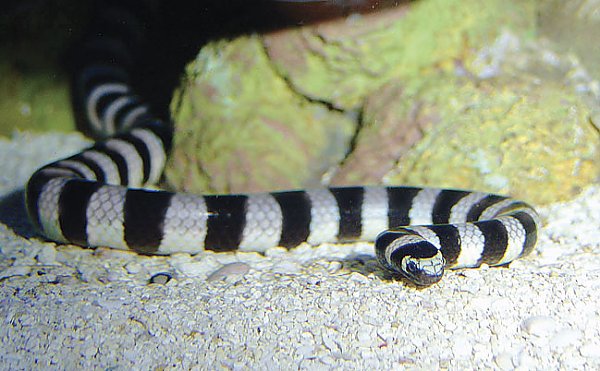
A male banded sea krait. Credit: Andrew Reitsma
SPECIES IN DETAIL
Banded Sea Krait
Laticauda colubrina
CONSERVATION STATUS: Safe for Now
CLIMATE CHANGE: Uncertain
At the Aquarium
Banded sea kraits do not have an Aquarium of the Pacific habitat. This information is supplied for use as a reference.
Geographic Distribution
Coastal waters of New Guinea, Pacific islands, Philippines, southeast Asia, Sri Lanka, and Japan
Habitat
Sea kraits are unique among sea snakes. They are amphibious, able to live on land or in the ocean. However, they are most commonly found in shallow tropical marine environments, coral reefs, and mangrove swamps to a maximum depth of 10 m (33 ft) On land they inhabit sandy beaches, coral islands, and occasionally low hanging trees.
Physical Characteristics
Sea kraits have a cylindrical body shape with a laterally compressed, paddle-like tail. They are distinctly banded with 20 to 65 black bands on a usually blue or blue-gray body. These bands extend from the neck area to the tip of the tail. The ventral (bottom) surface of the body is usually lighter than the top. The black head has yellowish accents.
Size
Adult males can reach 75 cm (30 in). Females are significantly larger than males, reaching 128 cm (50 in) in length.
Diet
In their natural habitat, sea kraits feed primarily on eels, but will occasionally prey on small fishes when they are able to trap them in the crevices of a reef.
Because their bodies are larger and can withstand the increased pressure of greater depths, females often hunt in areas not available to the smaller males, which cannot survive at the same depths.
Reproduction
Males reach sexual maturity at about 18 months and females from 18-24 months. Most sea snakes bear their young live in the water, but the banded sea krait lays eggs on land, either on the sand or just under it. Courtship and mating also occur on land. Large, dense populations of the snakes can be found on relatively small islands during the breeding season. These snakes often undertake long migrations to reach their breeding grounds, frequently returning to the same area.
Behavior
Banded sea kraits leave the ocean for land at about 10 day intervals, usually at night, to digest food, engage in courtship, lay eggs, and slough skin. In the breeding season, the movement to land is more frequent. On land, the snakes drink fresh water.
Adaptation
Sea kraits have many adaptations that enable them to live in both marine and land environments. Large belly scales, similar to those on land snakes, assist them in moving on land and climbing low hanging tree branches. A salt gland under the tongue gives them the ability to expel excess salt absorbed from the marine environment. When they are in the water, nasal valves and close fitting scales around the mouth act as seals to keep them from taking in water. Paddle shaped tails provide propulsion. Lungs that are proportionally much larger than their land based relatives enable them to spend long periods of time under water, from an average of 15-30 minutes to almost two hours. They have the ability to “breath” or exchange gases through the skin as well as the lungs.
Conservation
The population of sea kraits is threatened by destruction of both their aquatic and land habitats for development, and conversion to aquaculture farms.
Special Notes
The venom of the sea krait affects both muscles and nerves. It is 10 times more toxic than that of a rattlesnake. Each snake can produce up to 10-15 mg (0.0004-0.0005 oz) of venom. Only a fraction of the amount produced is a lethal dose.
It is estimated that the skin of the sea krait absorbs 1/5 of its total oxygen needs and eliminates almost all the carbon dioxide the snake produces.
SPECIES IN DETAIL | Print full entry
Banded Sea Krait
Laticauda colubrina
CONSERVATION STATUS: Safe for Now
CLIMATE CHANGE: Uncertain
Banded sea kraits do not have an Aquarium of the Pacific habitat. This information is supplied for use as a reference.
Coastal waters of New Guinea, Pacific islands, Philippines, southeast Asia, Sri Lanka, and Japan
Sea kraits are unique among sea snakes. They are amphibious, able to live on land or in the ocean. However, they are most commonly found in shallow tropical marine environments, coral reefs, and mangrove swamps to a maximum depth of 10 m (33 ft) On land they inhabit sandy beaches, coral islands, and occasionally low hanging trees.
Sea kraits have a cylindrical body shape with a laterally compressed, paddle-like tail. They are distinctly banded with 20 to 65 black bands on a usually blue or blue-gray body. These bands extend from the neck area to the tip of the tail. The ventral (bottom) surface of the body is usually lighter than the top. The black head has yellowish accents.
Adult males can reach 75 cm (30 in). Females are significantly larger than males, reaching 128 cm (50 in) in length.
In their natural habitat, sea kraits feed primarily on eels, but will occasionally prey on small fishes when they are able to trap them in the crevices of a reef.
Because their bodies are larger and can withstand the increased pressure of greater depths, females often hunt in areas not available to the smaller males, which cannot survive at the same depths.
Males reach sexual maturity at about 18 months and females from 18-24 months. Most sea snakes bear their young live in the water, but the banded sea krait lays eggs on land, either on the sand or just under it. Courtship and mating also occur on land. Large, dense populations of the snakes can be found on relatively small islands during the breeding season. These snakes often undertake long migrations to reach their breeding grounds, frequently returning to the same area.
Banded sea kraits leave the ocean for land at about 10 day intervals, usually at night, to digest food, engage in courtship, lay eggs, and slough skin. In the breeding season, the movement to land is more frequent. On land, the snakes drink fresh water.
Sea kraits have many adaptations that enable them to live in both marine and land environments. Large belly scales, similar to those on land snakes, assist them in moving on land and climbing low hanging tree branches. A salt gland under the tongue gives them the ability to expel excess salt absorbed from the marine environment. When they are in the water, nasal valves and close fitting scales around the mouth act as seals to keep them from taking in water. Paddle shaped tails provide propulsion. Lungs that are proportionally much larger than their land based relatives enable them to spend long periods of time under water, from an average of 15-30 minutes to almost two hours. They have the ability to “breath” or exchange gases through the skin as well as the lungs.
The population of sea kraits is threatened by destruction of both their aquatic and land habitats for development, and conversion to aquaculture farms.
The venom of the sea krait affects both muscles and nerves. It is 10 times more toxic than that of a rattlesnake. Each snake can produce up to 10-15 mg (0.0004-0.0005 oz) of venom. Only a fraction of the amount produced is a lethal dose.
It is estimated that the skin of the sea krait absorbs 1/5 of its total oxygen needs and eliminates almost all the carbon dioxide the snake produces.