


Mountain Yellow-legged Frog
Rana mucosa
The mountain yellow-legged frog is an endangered species of frog that is endemic to California and named for their brightly colored undersides. Once the most abundant amphibian in their range, its population is now said to have declined by approximately 95%. The Aquarium of the Pacific and other institutions are part of conservation efforts to save this species by rearing young frogs and releasing them back to their mountain homes.
Originally published: May 14, 2026
Last updated: June 16, 2026
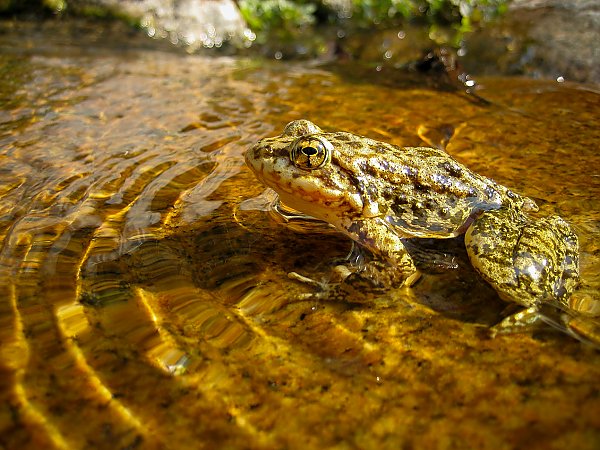
Mountain yellow-legged frog Credit: U.S. Geological Survey
SPECIES IN DETAIL
Mountain Yellow-legged Frog
Rana mucosa
CONSERVATION STATUS: Endangered
Geographic Distribution
They are endemic to California and found within the San Jacinto Mountains, the San Bernardino Mountains, the San Gabriel Mountains, and the Southern Sierra Nevada.
Habitat
They are native to California’s San Bernardino, San Jacinto and San Gabriel mountain ranges. They live at high elevations of 1,000 feet or more, primarily occupying cold-water, fishless streams that are fed by snowmelt.
Physical Characteristics
They are named for their bright yellow to yellow-orange underside and legs and have spotty brown coloration used to blend in with lichen and camouflage. As amphibians, they have no scales and their skin is moist and slimy.
Size
Up to 10 centimeters (4 inches) in length.
Diet
They have a sticky tongue which is ideal for their diet of insects like mosquitoes, beetles, ants, bees, wasps, flies and dragonflies. They are important to the food web of their habitat as they are prey to fish/birds as tadpoles and become prey for snakes and other animals as adults.
Reproduction
The female will lay eggs which the male will fertilize. They grow quite slowly due to their cold water environment, taking between 1-5 years to complete metamorphosis and emerge from the water as a frog.
Behavior
They make a very distinctive clicking sound, as they have no vocal sacs.
Adaptation
The mountain yellow-legged frog’s skin is very important to them as they use it to absorb oxygen, water, and nutrients. The black dots on their skin produce a mucus that protects them from infection. They also have very strong legs to help them swim.
Longevity
Unknown
Conservation
These frogs were once the most populous vertebrate in their range, but their numbers dwindled to fewer than 200 in the wild in 2021. This is primarily due to habitat loss, climate change, and invasive predators.
Non-native trout were introduced from the late 1800s to 1900s for recreational fishing and began eating the mountain yellow-legged frog’s tadpole population. Due to them staying in the tadpole stage for 4-5 years, this was especially damaging. The trout were removed in some areas and the population began to recover.
The Chytrid fungus has also affected this frog’s population in multiple stages of its lifecycle. It damages the mouth of tadpoles. In adults, it can cause death by causing the frog’s skin tissue to become leathery, preventing them from breathing.
These frogs are also at high risk due to climate change & habitat destruction, with their habitat being affected by drought and wildfires. In September and October 2020, the Bobcat Fire at the Angeles National Forest ripped through approximately 95% of the frog’s habitat and devastated the recovery efforts. After the fire, the upcoming rainy season turned the burn area into a mudslide and filled the waterways with runoff. Government agencies sent biologists to collect all frogs and tadpoles that could be found in the hope of helping the species survive.
The Aquarium of the Pacific and other institutions have partnered with the USGS (United States Geological Survey) to conserve the mountain yellow-legged frogs. By raising the tadpoles on site at the Aquarium, we are giving them a head start, which makes a big difference to their success post release. They typically take about a year to metamorphose into frogs. USGS determines the release sites and what life-stage or size of frog they would like to release year-to-year (i.e., they might only want to release larger-sized animals on a year that’s a bit drier, or more/smaller animals when there’s a lot of water/been a lot of rain). As of 2025, the Aquarium of the Pacific has reared and released 638 frogs.
The mountain yellow-legged frog is protected by both the federal and state Endangered Species Acts. They also have Critical Habitat Designation in much of their native habitat ranges. Both the Acts and the Designations help to protect the frogs from the introduction of non-native predators, such as trout and bullfrogs and maintain critical habitat conditions (such as water quality, destructive pesticides and other degradation of habitat conditions).
Special Notes
Adults and tadpoles can overwinter at the bottom of deep pools or lakes that do not freeze completely.
Adults are carnivorous, but tadpoles are herbivorous.
SPECIES IN DETAIL | Print full entry
Mountain Yellow-legged Frog
Rana mucosa
CONSERVATION STATUS: Endangered
They are endemic to California and found within the San Jacinto Mountains, the San Bernardino Mountains, the San Gabriel Mountains, and the Southern Sierra Nevada.
They are native to California’s San Bernardino, San Jacinto and San Gabriel mountain ranges. They live at high elevations of 1,000 feet or more, primarily occupying cold-water, fishless streams that are fed by snowmelt.
They are named for their bright yellow to yellow-orange underside and legs and have spotty brown coloration used to blend in with lichen and camouflage. As amphibians, they have no scales and their skin is moist and slimy.
Up to 10 centimeters (4 inches) in length.
They have a sticky tongue which is ideal for their diet of insects like mosquitoes, beetles, ants, bees, wasps, flies and dragonflies. They are important to the food web of their habitat as they are prey to fish/birds as tadpoles and become prey for snakes and other animals as adults.
The female will lay eggs which the male will fertilize. They grow quite slowly due to their cold water environment, taking between 1-5 years to complete metamorphosis and emerge from the water as a frog.
They make a very distinctive clicking sound, as they have no vocal sacs.
The mountain yellow-legged frog’s skin is very important to them as they use it to absorb oxygen, water, and nutrients. The black dots on their skin produce a mucus that protects them from infection. They also have very strong legs to help them swim.
Unknown
These frogs were once the most populous vertebrate in their range, but their numbers dwindled to fewer than 200 in the wild in 2021. This is primarily due to habitat loss, climate change, and invasive predators.
Non-native trout were introduced from the late 1800s to 1900s for recreational fishing and began eating the mountain yellow-legged frog’s tadpole population. Due to them staying in the tadpole stage for 4-5 years, this was especially damaging. The trout were removed in some areas and the population began to recover.
The Chytrid fungus has also affected this frog’s population in multiple stages of its lifecycle. It damages the mouth of tadpoles. In adults, it can cause death by causing the frog’s skin tissue to become leathery, preventing them from breathing.
These frogs are also at high risk due to climate change & habitat destruction, with their habitat being affected by drought and wildfires. In September and October 2020, the Bobcat Fire at the Angeles National Forest ripped through approximately 95% of the frog’s habitat and devastated the recovery efforts. After the fire, the upcoming rainy season turned the burn area into a mudslide and filled the waterways with runoff. Government agencies sent biologists to collect all frogs and tadpoles that could be found in the hope of helping the species survive.
The Aquarium of the Pacific and other institutions have partnered with the USGS (United States Geological Survey) to conserve the mountain yellow-legged frogs. By raising the tadpoles on site at the Aquarium, we are giving them a head start, which makes a big difference to their success post release. They typically take about a year to metamorphose into frogs. USGS determines the release sites and what life-stage or size of frog they would like to release year-to-year (i.e., they might only want to release larger-sized animals on a year that’s a bit drier, or more/smaller animals when there’s a lot of water/been a lot of rain). As of 2025, the Aquarium of the Pacific has reared and released 638 frogs.
The mountain yellow-legged frog is protected by both the federal and state Endangered Species Acts. They also have Critical Habitat Designation in much of their native habitat ranges. Both the Acts and the Designations help to protect the frogs from the introduction of non-native predators, such as trout and bullfrogs and maintain critical habitat conditions (such as water quality, destructive pesticides and other degradation of habitat conditions).
Adults and tadpoles can overwinter at the bottom of deep pools or lakes that do not freeze completely.
Adults are carnivorous, but tadpoles are herbivorous.