Fresh Voices
Caring for Jelly Cyborgs
Olivia Cleek dedicates herself to the care of sea jellies so that researchers can gain answers about our quickly changing ocean.
If you’ve been fortunate enough to stare at a tank of jellies, you understand why they are some of the most popular animals in an aquarium. The gentle, mesmerizing swirl of their gelatinous bodies seems to provide us with permission to slow down and breathe.
Jellies are the ultimate drifters. Without a brain, they are unable to decide on their destination; instead, they exist in a state of readiness to thrive wherever the current takes them.
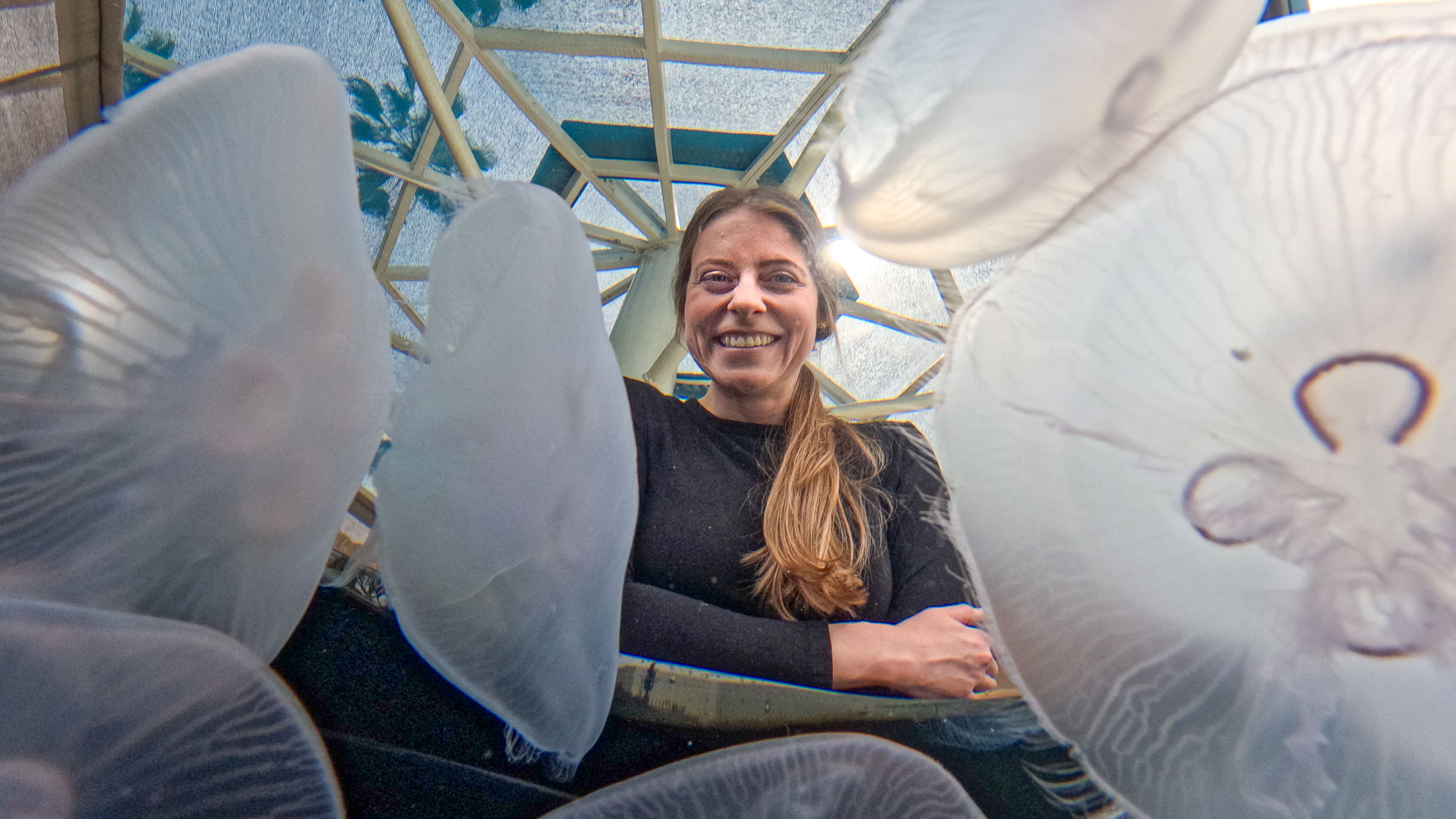
Though sea jellies are anatomically simple, their care requires a different level of patience and precision. I work with moon jellies (Aurelia coerulea), where every maintenance task must be conducted with a soft touch to avoid damaging their fragile bells. This specific set of skills provides the biological anchor for my current collaboration with researchers at the California Institute of Technology.
Instead of relying on costly underwater robots, the Dabiri Lab has successfully developed the ability to create a biohybrid “cyborg” jelly to gather environmental data about the ocean. They integrate a small microelectronic device with the jelly’s natural physiology so that researchers can send electric signals to the jelly’s muscles to guide the animal’s movement.
The best part? Jellies lack a central nervous system. They do not experience pain and heal rapidly once the device is removed, making them the ideal subject for the job. It is a perfect way to marry biology and technology to help us gain answers about our quickly changing ocean.
While the researchers focus on the pulse of the electronic signals, my role is to maintain the pulse of the animal itself, ensuring that the jelly is healthy. By maintaining optimum health and ideal water conditions, I provide the stable foundation necessary for this cutting-edge research to move forward.
Although I currently work in the world of jelly husbandry, my career has mirrored the versatility of sea jellies.
Raised in a small village in southern Ohio, far from the ocean, I knew from an early age that I wanted to work with animals. That led to earning a bachelor’s degree in zoology from Ohio State University with a rigid plan of becoming a zookeeper.
However, a summer internship in Hawaii changed my trajectory completely. I learned the basics of aquatic fish and invertebrate husbandry and knew that I had discovered my calling.
After that, I leaned into the ever-evolving currents of the industry and said yes to all opportunities. I have cared for sharks and rays, raised green sea turtle hatchlings, and managed the delicate life cycles of seahorses and Pacific yellow tangs. From training a Hawaiian monk seal to leading breeding and recovery efforts for endangered white abalone and sunflower sea stars, each role added a new layer of technical expertise to prepare me for wherever the next current would take me.
Looking back, I realize that by letting go of my original plan to be a zookeeper and allowing myself to remain open to the unpredictable currents of marine biology, I ended up gaining more skills and a more fulfilling career than I had ever envisioned. I’m proud to work with so many animals including sea jellies.
Olivia Cleek
Olivia Cleek is an aquarist at Cabrillo Marine Aquarium, focusing on endangered species and sea jelly care. She recently received her master’s degree in environmental science from Oregon State University where she studied the presence and distribution of basking sharks along the west coast of North America using social media posts.