Jelly Dreamscapes
Step into the captivating world of sea jellies, and discover their beauty, diversity, and soul-soothing qualities.
Sea jellies are a beautiful, diverse group of animals. They appear anatomically basic—without major organs such as a brain or heart—yet have complex life cycles and require specifically engineered environments that mimic the open ocean.
Through research and dedication to maintaining the highest standards of care for these animals, the Aquarium of the Pacific has successfully cultured over 40 species of sea jellies. The culmination of years of commitment to these animals has resulted in Jelly Dreamscapes, our first immersive exhibit that will bring to life the beauty and tranquility of these gelatinous creatures.
What are Sea Jellies?
Sea jellies have been around for more than 500 million years, before the time of dinosaurs. They have adapted to every ocean environment on Earth: tropical to Arctic temperatures, deep sea to shallow reefs, and freshwater to saltwater.
Remarkably, these resilient animals only have an average life span of about one year. However, this can vary depending on the species.
Sea jellies come in a multitude of sizes and colors. They are invertebrates, meaning they do not have a backbone. However, unlike most other aquatic invertebrates, sea jellies also do not have a heart, brain, or gills. Their bodies are 95% water, causing some species to be almost completely translucent in appearance. They vary in color from white to green, blue, orange, and more.
There are several types of sea jellies. Scyphozoan, or true jellies, are some of the most recognizable. True jellies have a bell, oral arms, and tentacles. Depending on the species, they may have up to 1,200 tentacles. These tentacles are equipped with nematocysts, which are stinging cells used to defend themselves against predators and immobilize prey.
A sea jelly’s diet consists of mostly zooplankton, but they may also indulge in small crustaceans, fish, or even other sea jellies. Once a prey item has been stunned by the nematocysts, the oral arms transport the prey to the mouth at the center of the bell.
A Sea Jelly Story
Sea jellies can reproduce through both sexual and asexual methods. The most studied reproduction methods belong to true jellies like moon jellies.
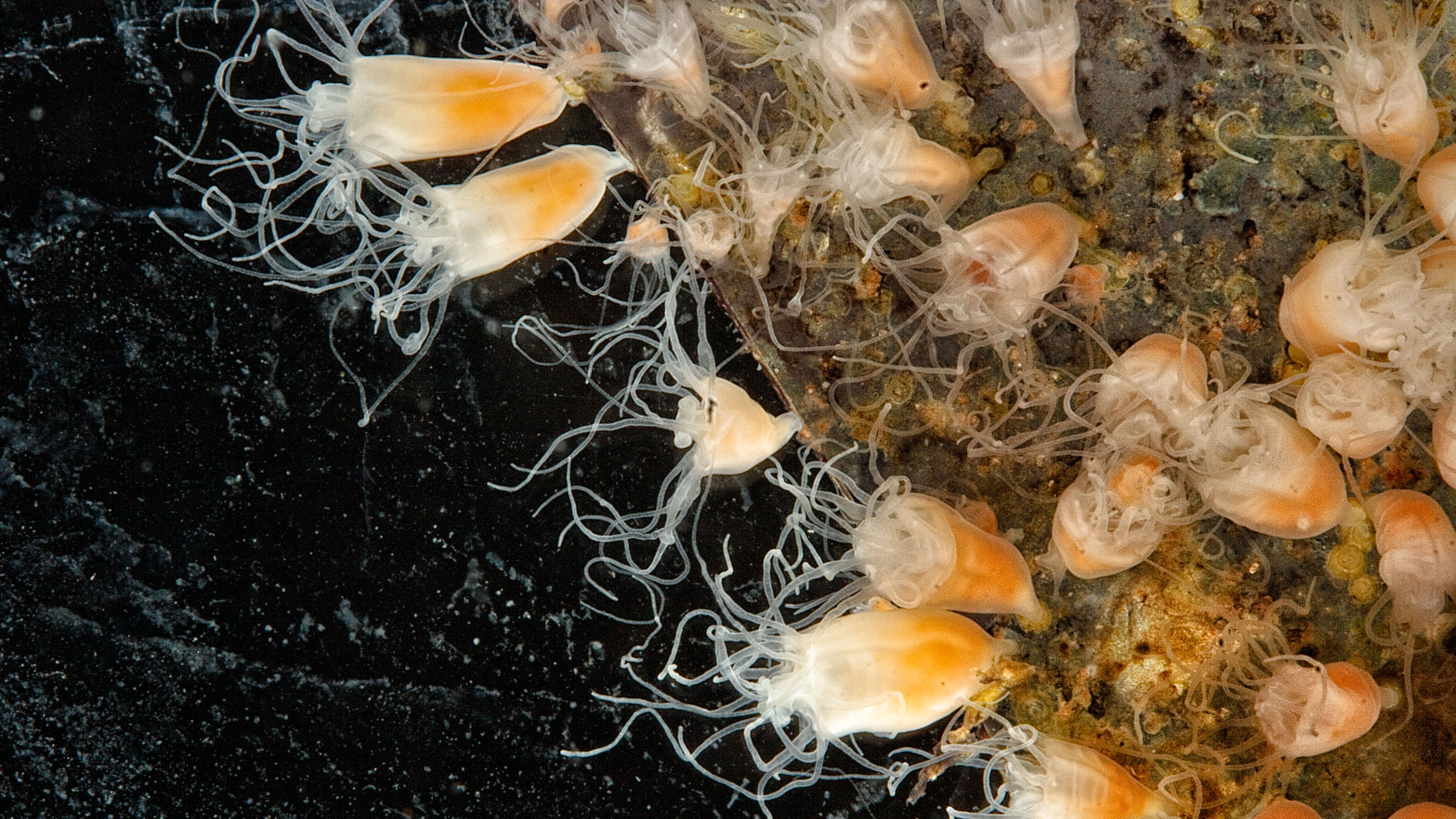
The first stage of their life starts after a fertilized egg (sexual reproduction) develops into a planula larva. A planula larva is a small, flat, free-swimming or crawling organism. The planula larva travels around, looking for a suitable surface to settle on, like a rock, shell, macroalgae, or a piece of driftwood. Once settled, the larva transforms into a polyp.
The polyp stage closely resembles a small sea anemone, feeding by capturing prey in its tentacles. When the polyp has eaten and grown enough, and if environmental conditions are right, the polyp will begin to divide. The polyp will clone itself into a stack of small discs, one on top of the other. These small discs pulsate and eventually detach, becoming ephyra. This is a form of asexual reproduction. Each ephyra from the same polyp is genetically the same.
As the ephyra grows, it begins to look like a small adult sea jelly, which is known as a medusa. The medusa stage is what is typically seen at the Aquarium.
Jelly Culture Coordinator Josh Wagner leads members of the jelly care team at the Aquarium in the best methods for sea jelly culture. The team has become experts in the requirements for each stage of life for all jelly species cultured at the Aquarium.
The jelly care team maintains clean environments for jellies, taking particular care during their polyp stage when they are more susceptible to environmental stressors. Each exhibit and culture habitat is wiped and siphoned daily to remove algae and waste. This helps to ensure optimal water quality for the animals to thrive.
The jellies are fed four times a day, including two brine shrimp meals and two specialty meals. The specialty meals can be a variety of different foods that are tailored to each species being fed, such as blended-up seafood, like mahi-mahi or krill. The specialty meal chosen often depends on which life stage the jelly is in; for example, ephyra may be offered a different species of zooplankton, like rotifers, due to their small size.
“We have to make sure that their diet is perfect for them,” said Wagner. “They’re so small that if you feed them something too large, they’ll become negatively buoyant, sink to the bottom.”
Sea jellies reside in open water, often drifting with the ocean’s currents. At the Aquarium, most sea jellies are housed in Kreisels, which is a specialized habitat that has no corners, creating a continuous circular flow mimicking an open ocean environment. The word Kreisel comes from the German word for gyroscope or spinning top; named after the gentle spin the water creates in the tank.
“A jelly’s bell is so sensitive that if it were in a regular fish tank, if it gets stuck in the corner, it can’t get out,” Wagner explains. “Kreisels keep jellies moving towards the center of the tank, so they’re constantly pulsing.”
Our Sea Jelly Lineup
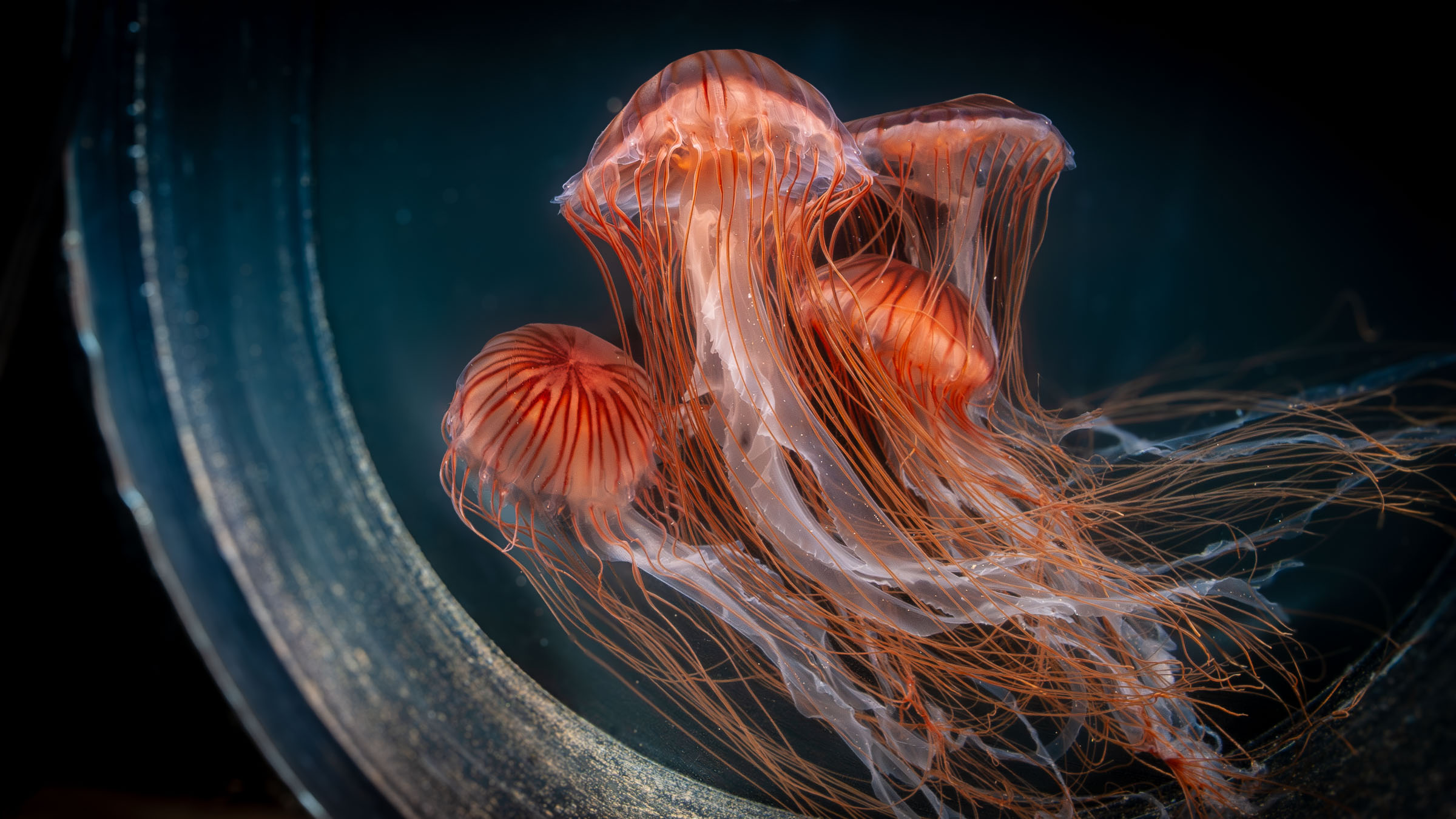
Jelly Dreamscapes will allow guests to explore the beauty and diversity of hundreds of colorful sea jellies at the Aquarium. It will showcase one of the most diverse collections of sea jellies in the United States. Species of graceful sea nettles, quick-pulsing blubber jellies, and shimmering rainbow comb jellies will only be some of the animals seen throughout the gallery.
A mainstay at the Aquarium is the moon jelly (Aurelia coerulea). This jelly reaches around two inches in length and is one of the most widely distributed species of sea jelly found in our World Ocean. This species will be seen in Jelly Dreamscapes, and will continue to be found at the Aquarium’s outdoor Moon Jelly Touch Lab on Harbor Terrace, where guests can touch and experience moon jellies up close.
Spotted lagoon jellies (Mastigias papua) will be returning. This species ranges from a greenish blue to golden-brown color with yellow, white, or brown spots. The color variations are attributed to the symbiotic algae that lives inside the jelly, similar to a coral polyp and zooxanthellae algae.
The most common sea jelly found in the Mediterranean, the barrel jelly (Rhizostoma pulmo), will make its debut at the Aquarium. This species is a white to pale yellow jelly, with a striking purple to blue fringe around the base of the bell. They are members of the Rhizostomae order, which also includes the spotted lagoon jelly.
Various species of sea nettles will be found throughout the gallery. They can grow many feet long, making them some of the largest species of sea jelly. The South American sea nettle (Chrysaora plocamia) can grow six feet or more in length, while the Pacific sea nettle (Chrysaora fuscescens) can grow as long as fifteen feet or more.
The number of exhibits dedicated to comb jellies will increase, starting with the California sea gooseberry (Hormiphora californensis). This species of comb jelly, or ctenophore, has tiny hairlike structures called cilia running down its sides. When light refracts off their cilia, it causes a glowing rainbow effect. These little jellies have an oval-shaped gelatinous body that can reach up to an inch in length and two long tentacles.
Other species of sea jellies that will be drifting their way to the Aquarium in the near future include spotted comb jellies, cannonball jellies, and more.
The Future of Jelly Species at the Aquarium
Wagner’s work with sea jellies has given him the opportunity to learn from other aquarists and researchers from across the country and around the world, even as far as Japan. In the future, he hopes to increase the diversity of species at the Aquarium of the Pacific and share the successful techniques he has discovered with aquariums around the world.
“It’s fun to get new species that other aquariums haven’t had before, and be the first ones to display them,” said Wagner. “But it’s just as fun to share that knowledge and help other aquariums out as well.”
These unique and delicate creatures are beloved members of our World Ocean and the Aquarium family. As our jelly collection evolves, guests will be able to enjoy their soothing nature amidst meditative lighting and dreamlike soundscapes in Jelly Dreamscapes. Guests will even get the opportunity to see how the animals receive state-of-the-art animal care from staff.