Conservation Corner
Jellies: Canaries of Change
“Canary in a coal mine” is a phrase that is used to describe when something is an early indicator of trouble.
The phrase has origins from the late 1800s when canaries were used in coal mining operations to detect toxins. The birds were more sensitive than their human counterparts, allowing humans to quickly vacate the affected areas.
Since then, the phrase has been extended to several other species serving in similar warning capacities. One of them is sea jellies.
Sea jellies, or jellyfish as the public often calls them, are animals that are both relaxing and terrifying to many. Relaxing because of their beauty—their gelatinous bodies more closely resemble works of art than animals. Their pulsing and flowing movements are visually soothing and were a stress reliever for many during a tense COVID pandemic when live webcams of jellies in aquariums provided a welcome escape.
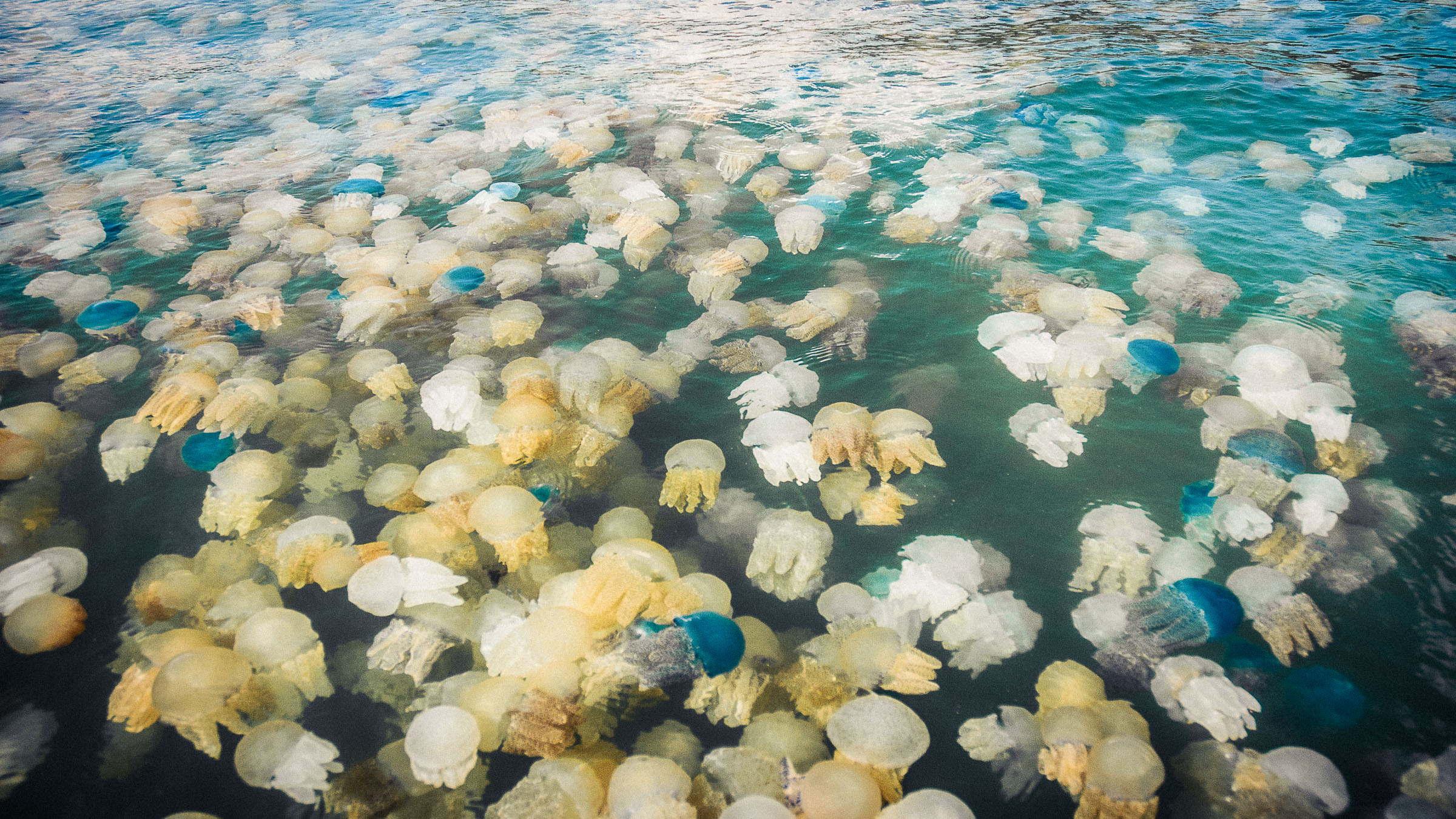
Paradoxically, jellies are equally terrifying to many, perhaps even to the same people. This is due to their feeding mechanisms, which involve nematocysts or stinging cells. The power of the sting varies by species, and many are unpleasant or worse on human skin. A large gathering of sea jellies, also known as a smack, could be a feature of a nightmare.
While this fear is certainly valid, a smack can also be concerning because of what it signals about the ecosystem. A large population burst of jellies shows that the ecosystem is changing rapidly, typically in a negative direction.
This is because jellies can thrive in polluted environments, such as those with excess nutrients from coastal runoff. Runoff areas experience algal blooms, which quickly decrease dissolved oxygen in the water, a key element for most living marine organisms like fish and crabs. However, their lower oxygen demands can allow jellies to thrive in these areas.
Once the jellies have a foothold, they are good at thriving. They outcompete other species by feeding on their larval, planktonic eggs, and juveniles. A positive feedback cycle is underway, further supporting the jelly population. This phenomenon has been seen in many places around the world, including the Mediterranean Sea, the Gulf of Mexico, and Japan.
In extreme examples, the negative impacts of the blooms extend beyond ecosystem impacts to human systems. Several nuclear power plants have been shut down by a jelly bloom interfering with equipment, as has a U.S. aircraft carrier.
While all of this is concerning, there is no reason to panic. There has not been, nor is it imminently forecasted, that we will have a global jelly takeover. Researchers have documented decadal changes in sea jelly populations, suggesting there are natural oscillations. Plus, a sea jelly’s life span is short, with some as brief as a few days. So, under the right conditions, a bloom can end as quickly as it takes off.
Bloom cycles are normal in parts of the world. For example, in the Chesapeake Bay, Atlantic sea nettle populations increase in summer months. Jellies thrive under warmer waters, so as the impacts of climate change are felt, the blooms in the Chesapeake are occurring earlier and more intensely. This reminds us of why sea jellies are called ‘canaries in the coal mine’ – warning us that ecosystem change is underway.
Scientists, including community scientists, are monitoring the changes to sea jelly populations. Regional maps can provide early warning systems to community members and tourists, and they allow us to better track changes over time in populations and their bloom durations.

Jennie Dean
Jennie Dean is the Aquarium’s vice president of conservation and policy. She focuses on the amplification and enhancement of the Aquarium’s work in species conservation and learning for all audiences. Previously Dean was a program director at the University of California, Los Angeles’ Institute of the Environment and Sustainability, where she oversaw programs engaging the private sector on corporate sustainability and consulted with island governments on sustainable development of their blue economy.