Horn Shark
Heterodontus francisci

Horn Shark
Heterodontus francisci
Horn shark populations remain stable but the impacts of warming waters should remain closely watched.
Morphology
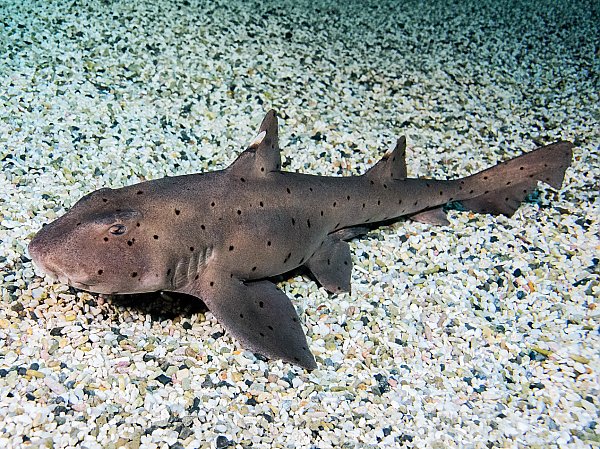
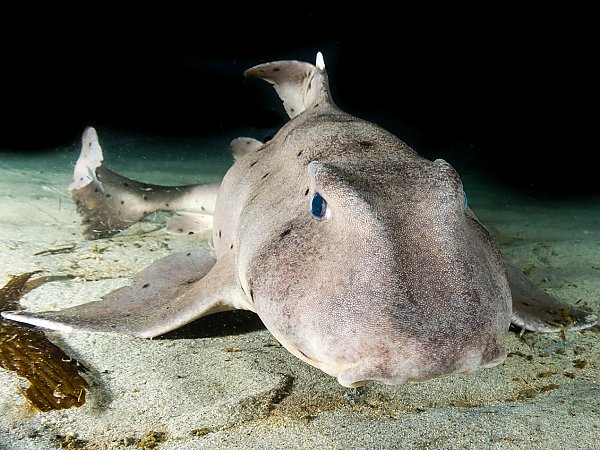
Horn sharks are mottled grey and brown with prominent black or dark brown spots. The white non-toxic spines (‘horns’) in front of each dorsal fin give the shark its name. Horn sharks maximum length is 1.22 meters with females typically larger (longer) than males. A typical adult shark weighs 6.8 kilograms.
They have sharp front teeth to grasp prey that is slippery while their back teeth are more like flat molars to crush their prey with shells. This is what gives them their Greek-origin name Heterodontus, or ‘different teeth’.
Habitat and Range
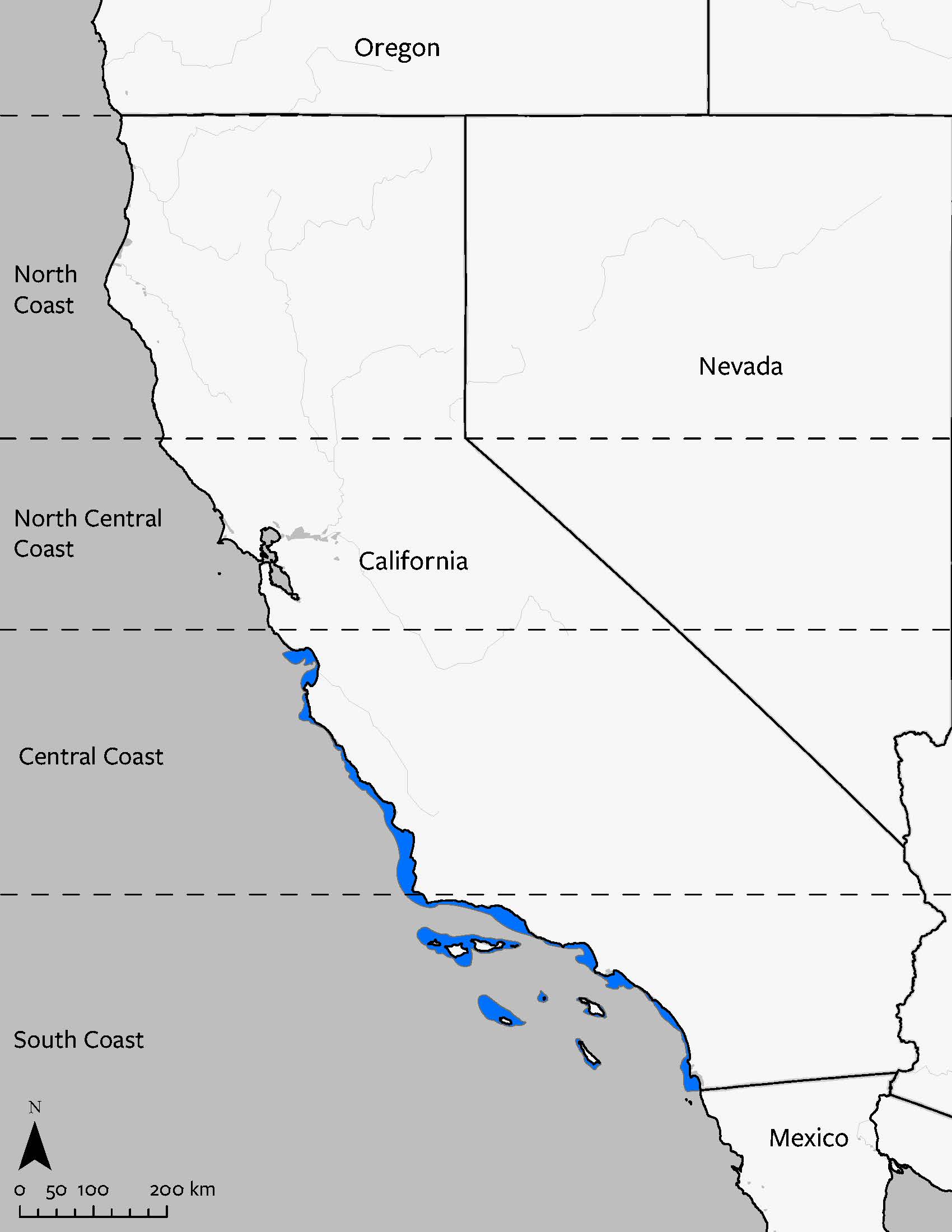
Horn sharks are found on the sea floor in coastal areas with a variety of cover including rocky reef, kelp forest, and sandy bottom from Central California (Monterey Bay) to the Gulf of California. They are typically found at shallow depths of less than 20 meters but have been observed as deep as 200 meters. Juveniles tend to be found in shallower, warmer areas (<10 meters), whereas adults are in cooler, deeper habitats.
Range Map
Reproductive Biology and Life History
Horn sharks mate in December-January and females can lay up to 24 corkscrew-shaped eggs, in a single season. The eggs are the same color as kelp and are approximately 13 centimeters long. Their corkscrew shape allows them to stay wedged in rocky areas or crevices. Following a 6-9 month incubation period, the eggs hatch into sharks measuring 15-17 centimeters long.
Horn sharks reach sexual maturity at 6-10 years of age, possibly earlier when in human care. Maximum life span is thought to be 25 years, but is not well-documented.
Ecology
As nocturnal foragers , horn sharks tend to rest and shelter in caves and crevices during the day, to protect their light sensitive eyes, and become active at night. Horn sharks are important predators that eat primarily benthic, or bottom-dwelling, animals including crustaceans, sea urchins, molluscs and small fish. Their predators include other sharks, marine mammals such as sea lions, and other large fish. Their horns aid as a defense and shelter anchoring mechanism.
Limited genetic studies suggest that sharks do not travel long distances over deep water or open ocean, such as between coastal areas and the Channel Islands. This is a behavior trait shared by other benthic elasmobranchs in the region.
Horn sharks have high site fidelity, or in other words they stay in the same place. Adults have been observed to return to the same resting place each day while foraging at night and their home range is estimated at approximately 8-10 hectares.
Horn sharks can appear to walk along the seafloor with their pectoral fins when searching for food at night.
Cultural Significance and Historical Context
Horn shark spines are made into jewelry. Some anecdotal reports suggest that collection of sharks for this use at popular dive sites is impacting local populations. However, there is no official study documenting this impact.
Date modified: April 2026

This animal can be found at the Aquarium of the Pacific
Primary ThreatsPrimary Threats Conditions
Threats and Conservation Status
The IUCN Red List has listed the horn shark as Least Concern and with a stable population trend, with the latest assessment completed in June 2024. The report notes that they are likely less impacted by fishing than other species given their preference for rocky bottom and nocturnal nature. The report shares that localized declines may occur due to high site fidelity.
This matches the data examined for this account. With the data from the Monitoring and Evaluation of Kelp Forest Ecosystems in the MLPA Marine Protected Area Network, observations in the South coast region have remained stable in the last 25 years. There is no significant difference in trend within or outside marine protected areas, and average observed density is comparable.
There is no commercial or significant recreational fishery for horn sharks in California. More often they are landed unintentionally as bycatch. In the Mexico portion of their range, they are taken by the artisanal gillnet fishery. Given the species’ high site fidelity, the impact of this fishery on the California population is not likely.
A few studies have shown horn sharks to be modestly temperature sensitive, with an increase in oxygen consumption when sea temperatures are increased. Other studies have shown that horn sharks have metabolisms that are relatively sensitive to temperature change. This may be especially true for juveniles, who seem to require a very specific, stable temperature. This temperature sensitivity implies that warming oceans may negatively impact horn sharks in the future. Further studies to understand these dynamics and impacts is warranted.
Population Plots
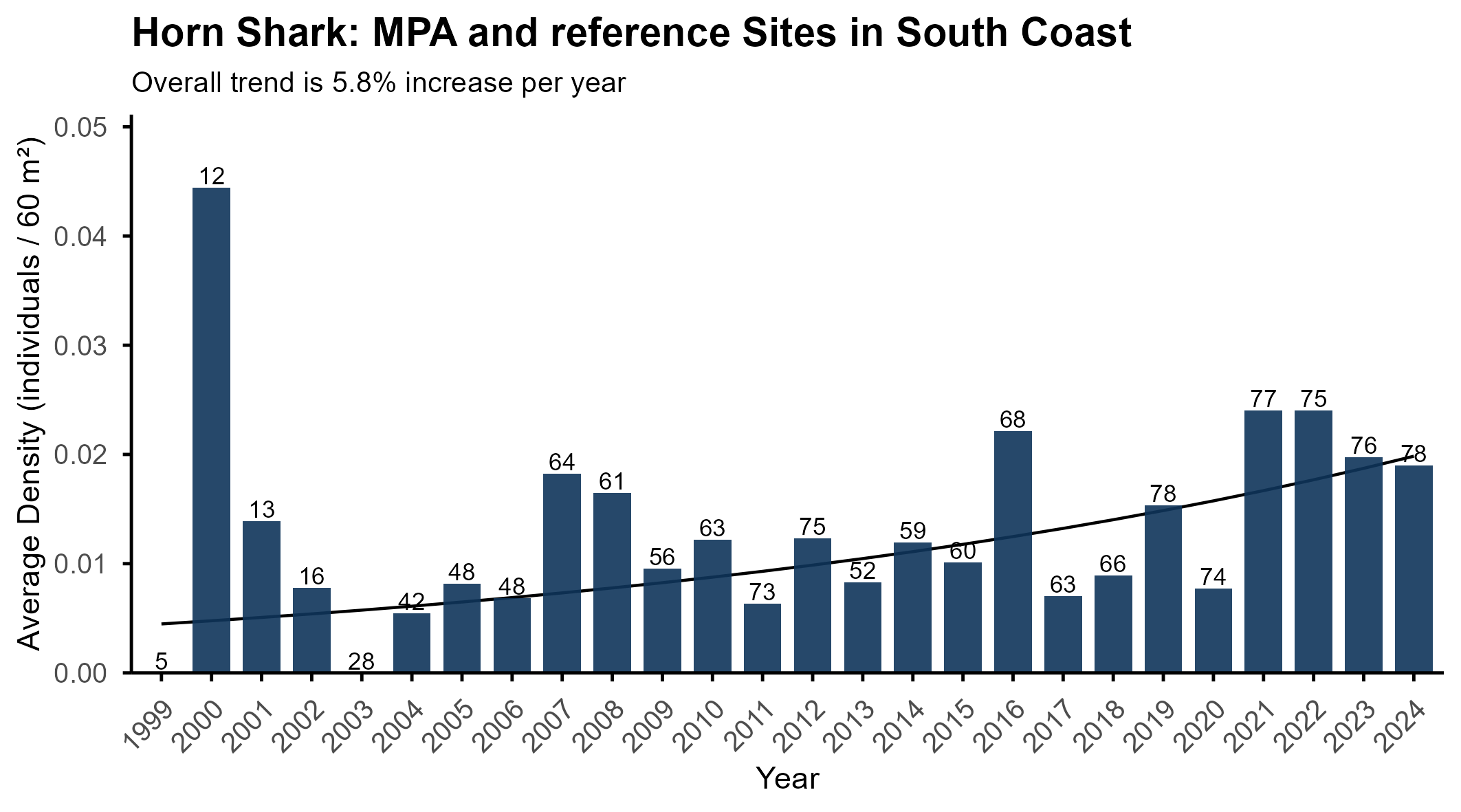
Data Source: Monitoring and Evaluation of Kelp Forest Ecosystems in the MLPA Marine Protected Area Network. California Ocean Protection Council Data Repository.
- Bauer. J. et al. (2025) Community-led management maintains higher predator biomass supporting kelp forests persistence in Baja California. Scientific Reports, 15: 23253. https://doi.org/10.1038/s41598-025-86140-6
- CA Marine Species Portal. (n.d.). https://marinespecies.wildlife.ca.gov/horn-shark/
- Canfield, J.S. (2021). Population genetics of the California horn shark (heterodontus francisci). [Doctoral dissertation, University of Hawai’i at Manoa]. https://scholarspace.manoa.hawaii.edu/server/api/core/bitstreams/5b0a11b1-34df-4f8b-ba60-dadbe459841d/content
- Compagno, L.J.V. (2001). Sharks of the world. An annotated and illustrated catalogue of shark species known to date. Volume 2. Bullhead, mackerel and carpet sharks (Heterodontiformes, Lamniformes and Orectolobiformes). FAO Species Catalogue for Fishery Purposes. No. 1, Vol. 2. Rome, FAO.
- Cortés-Fuentes C, Simental-Anguiano MDR, Galván-Magaña F, Medina-López MA. (2020). Feeding habits of the horn shark Heterodontus francisci (Girard, 1855) in the northwest of Baja California Sur, Mexico. Journal of Applied Ichthyology, 36 (6), 762-767. https ://doi.org/10.1111/jai.14004
- Domínguez Reza, R.H. (2017). Age and growth of the dogfish shark (Heterodontus francisci) in the Ojo de Liebre lagoon, Baja California Sur, Mexico. [Master's Thesis, Center for Scientific Research and Higher Education of Ensenada]. https://cicese.repositorioinstitucional.mx/jspui/handle/1007/2043
- Ebert, D.A. (2003). Sharks, Rays and Chimaeras of California. University of California Press.
- Gobalet, K.W. and Jones, T. L. (1995). Prehistoric native American fisheries of the central California coast. Transactions of the American Fisheries Society, 124(6), 813-823.
- Meese, E M. (2019). Diel, fine-scale spatial movements and activity patterns of California horn sharks, Heterodontus Francisci. [Masters Thesis, California State University, Long Beach].
- Meese, E.N., Lowe, C.G. (2020). Environmental effects on daytime sheltering behaviors of California horn sharks (Heterodontus francisci). Environmental Biology of Fishes, 103(6), 703–717. https://doi.org/10.1007/s10641-020-00977-6
- Meese EN, Lowe CG. Active acoustic telemetry tracking and tri-axial accelerometers reveal fine-scale movement strategies of a non-obligate ram ventilator. Mov Ecol. 2020 Feb 10;8:8. doi: 10.1186/s40462-020-0191-3. PMID: 32071719; PMCID: PMC7011439.
- Ramírez-Amaro, S. & Galván-Magaña, F. (2019). Effect of gillnet selectivity on elasmobranchs off the northwestern coast of Mexico. Ocean & Coastal Management 172, 105-116. https://doi.org/10.1016/j.ocecoaman.2019.02.001
- Rigby, C.L., Garcia, E. & Rohner, C.A. (2025). Heterodontus francisci. The IUCN Red List of Threatened Species 2025: e.T39333A124401602. https://dx.doi.org/10.2305/IUCN.UK.2025-2.RLTS.T39333A124401602.en
- Luongo, S. & Lowe, C. (2018). Seasonally acclimated metabolic Q10 of the California horn shark, Heterodontus francisci, Journal of Experimental Marine Biology and Ecology, 503,129-135. https://doi.org/10.1016/j.jembe.2018.02.006